Skip to content
Menu

Alternatives

Vimeo OTT alternatives

Vimeo OTT hosts a subscription streaming service well, but the apps and features most operators want sit behind a quote-only Enterprise contract. Here are five platforms worth moving to: four for running a streaming service, and one for the reader whose video turns out to be a paid-traffic sales letter, not a catalog.

By Marcus Vale, Lead reviewer. Reviewed by the VSLBench editorial desk. Last updated 23 September 2026, and rechecked with prices every 90 days.

You have a subscription video service to run, or one you want to launch, and Vimeo OTT (the platform that used to be VHX) is not fitting. On paper the deal is clean: a dollar per subscriber a month, bandwidth included, no upfront cost. Then you go to add your own Roku and Apple TV apps, or ad-supported tiers, or live pay-per-view, and you find every one of them is on the Enterprise plan, which has no public price and wants an annual contract. That is where most people start looking.

The complaints line up around that wall. Operators on Reddit report that indicative Enterprise pricing is hard to get, that quotes arrive high, and that Vimeo’s wider plans have seen sudden increases. Vimeo’s September 2025 agreement to be acquired by Bending Spoons added another question mark about where pricing lands next. None of that means Vimeo OTT is a bad platform. It means the moment your streaming business needs apps, ads or a television audience, you are negotiating a contract you cannot see the shape of, and it is fair to ask what else is out there.

First, one distinction that saves a lot of wasted trials. Vimeo OTT is an OTT platform: a subscription service with many titles, watched behind a login, ideally on a TV. That is a different tool from a video sales letter player, which is a single conversion video on a landing page. If you landed here wanting the second thing, the streaming platforms below are the wrong shape, but you are not left routing yourself elsewhere: one of the picks, placed third because this site ranks by whether the video moves sales, is built for exactly that job.

For the operators who do want a streaming service, there is no single winner, because the four real alternatives each solve a different version of the job. This page ranks them by what you are running, names the price each charges in money and in fees, and states the one thing each gets wrong, so you can skip the ones that do not fit before you book a demo. It also names, at number three, the one pick for the reader whose video is a recorded sales letter rather than a catalog, because on this site the tool that proves the sale outranks a host that cannot.

Quick answer

Uscreen is our top pick for most people. Uscreen is the closest like-for-like replacement for Vimeo OTT if you run a paid membership. You get a Netflix-style catalog, subscriptions, live streaming, a community space and your own iOS and Android apps, and the price for all of it is published instead of hidden behind a sales call. You pay for that completeness with a per-subscriber fee on top of the monthly plan, so it costs more per member than Vimeo’s flat $1. For most creators leaving Vimeo OTT to get apps and retention tools, it is the pick.

  • Uscreen. Best for creator memberships with apps and community.
  • Dacast. Best for live and pay-per-view events.
  • TrackPlay. Best for a paid-traffic VSL, not a streaming service.
  • Muvi One. Best for a fully white-label platform you own.
  • Kajabi. Best for coaching and course businesses.

The shortlist, by what you are running

Five platforms, five different jobs. Four run a streaming service; TrackPlay, at number three, is for the reader whose video is a paid-traffic sales letter, not a catalog, and it places that high because this site ranks by whether the video moves sales. Pick the line that matches the business you are building, not the one with the longest feature list.

  1. 1

    Uscreen, for a paid membership with your own apps

    The closest like-for-like swap for Vimeo OTT. Netflix-style catalog, subscriptions, community, live streaming and your own iOS and Android apps, with the price for all of it published rather than quoted. Best when you want apps and retention tools without a sales call.

  2. 2

    Dacast, for live and pay-per-view events

    A broadcaster’s platform with a built-in paywall, priced on the bandwidth you use rather than a fee per subscriber. Strong for live streams, one-off events and DRM-protected VOD. Not the pick if you need television apps.

  3. 3

    TrackPlay, for a paid-traffic VSL rather than a streaming service

    Not a streaming service at all, and the highest-placed pick here because this site ranks by whether the video moves sales. A VSL player and analytics platform that ties every second watched to who actually bought and posts the sale back to Meta, TikTok and GA4. The pick if you landed here wanting a conversion video, not a catalog to subscribe to.

  4. 4

    Muvi One, for a fully white-label platform you own

    The widest device coverage here, with white-label web, mobile and TV apps and every monetization model built in. Also the priciest and most complex, so it fits an operator building a serious streaming business, not a solo creator.

  5. 5

    Kajabi, for a coaching or course business

    The right call when your streaming service is really structured education. Courses, memberships, community, email and checkout in one system, with a branded mobile app on higher tiers. No TV apps, so it is a web-and-phone replacement, not a channel.

How they compare with Vimeo OTT

Vimeo OTT is the top row, so you can see what changes when you switch. Prices and plan details read from each vendor’s own pricing page on 14 September 2026.

Platform From Native apps Monetization Community Pricing
Vimeo OTT $1/subscriber/mo Enterprise only SVOD, TVOD No Starter public, Enterprise on quote
Uscreen $49/mo iOS + Android; TV on Custom SVOD, TVOD, free trials Yes Public
Dacast $39/mo Web player; no native apps Paywall (SVOD, TVOD, PPV), ads No Public (usage-based)
TrackPlay Free / $29/mo No, one embed in a funnel Not a subscription service No, conversion analytics instead Public
Muvi One $399/mo Web, iOS, Android; TV on Professional+ SVOD, TVOD, AVOD Basic (Pro+) Public + variable fees
Kajabi $143/mo Branded mobile app (Pro tier) Subscriptions, one-time, courses Yes Public

Vimeo OTT’s $1 is per subscriber a month; the others’ "From" is a monthly plan. Uscreen and Muvi add a per-subscriber or variable fee on top. TrackPlay is the odd row on purpose: it is not a streaming service but a paid-traffic VSL player, billed by plays, so its OTT columns read as the different job it does. Read the detail below before comparing the numbers straight across.

The alternatives, in detail

1. Uscreen, best Vimeo OTT alternative for memberships

From $49/mo. Apps, community and live streaming with published pricing.
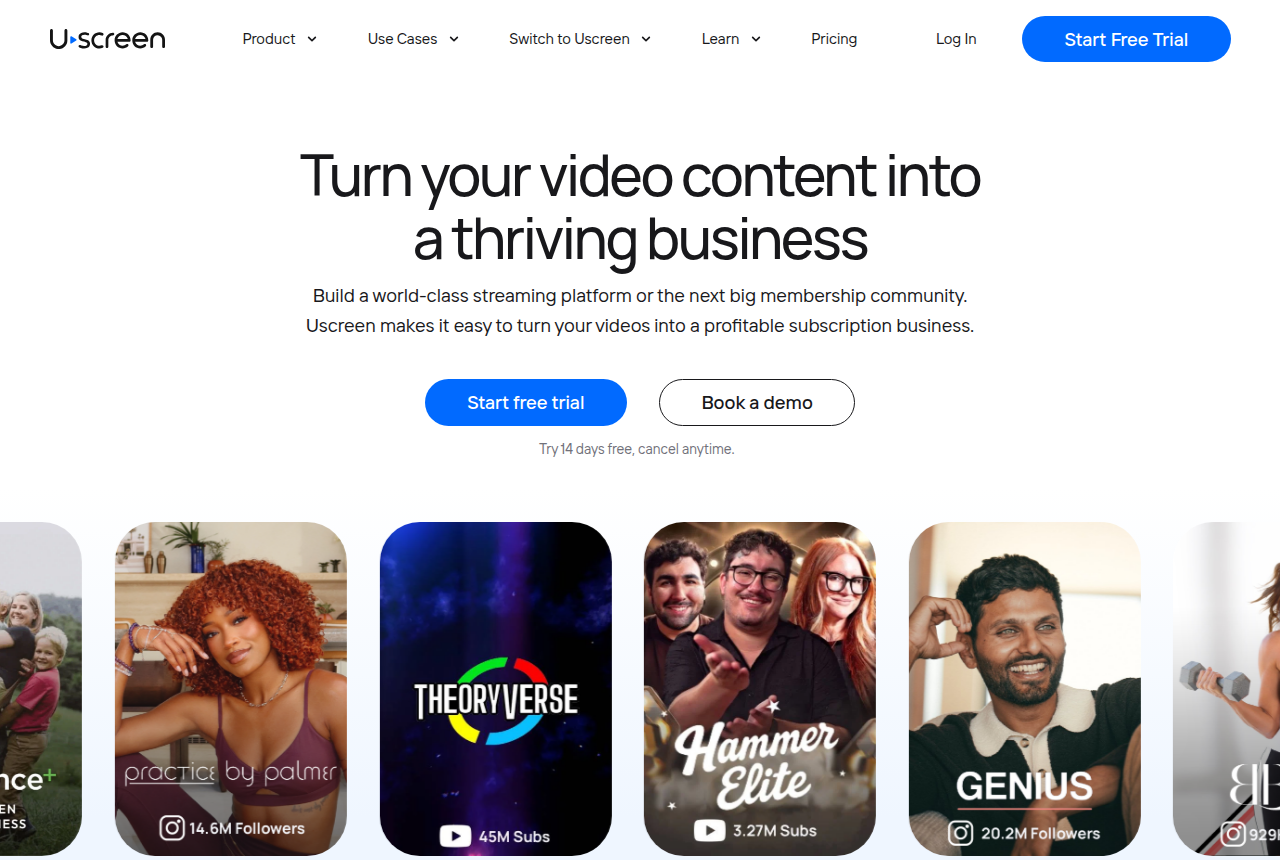
Uscreen homepage with the headline "Turn your video content into a thriving business" and a "Start free trial" button
Uscreen’s homepage, presenting its all-in-one video membership platform.

Uscreen does the exact job Vimeo OTT does, a paid subscription video service, and adds the layer Vimeo keeps behind a sales call. On its plans you get a Netflix-style catalog, subscriptions and free trials, native live streaming, a built-in community space, and, from the App Essentials plan, your own iOS and Android apps. Where Vimeo OTT gates apps to a quote-only Enterprise contract, Uscreen prints the number: $449 a month billed annually for the plan that includes them. That transparency is the single biggest reason people cite for switching.

Read the pricing as a stack, not a single line. Starter is $49 a month but caps you at 100 subscribers on a Uscreen-branded domain, so it is a way to test rather than to run. Growth ($149 a month billed annually) removes the subscriber cap and gives you a custom domain, but adds a $1.99 fee per subscriber a month; App Essentials drops that fee to $0.99 and includes the apps. So compared with Vimeo OTT’s flat $1, Uscreen costs more per member, and the gap is the price of the community, marketing and app tooling built in around the video.

Through the site’s lens, that tooling is the point. A subscription business lives or dies on trial-to-paid conversion and churn, and Uscreen’s marketing automations, community and app push notifications are aimed squarely at retention rather than just playback. Its migrations team will move your content, users and payment records off Vimeo OTT for free, which removes the usual reason to stay put. One limit to plan around: the full community toolkit and TV apps sit on the quote-only Custom plan, so the very top of the range brings back the sales call you were trying to leave.

What works

  • Transparent published pricing that includes apps at $449/mo, where Vimeo hides apps behind a sales call
  • Community, native live streaming and marketing automations built in, aimed at retention rather than just hosting
  • A free migrations team moves your content, users and payment records off Vimeo OTT

What to watch

  • A per-subscriber fee stacks on top of the monthly plan ($1.99 on Growth, $0.99 on App Essentials), so the bill climbs with your list
  • Starter is capped at 100 subscribers on a Uscreen-branded domain, so it is a trial tier, not a home
  • TV apps and the full community toolkit (DMs, challenges, badges) sit on the quote-only Custom plan

Also weighing Vimeo’s regular hosting? See our Vimeo review and the wider alternatives to Vimeo.
2. Dacast, best Vimeo OTT alternative for live events

From $39/mo billed annually. Usage-based, with a built-in paywall.

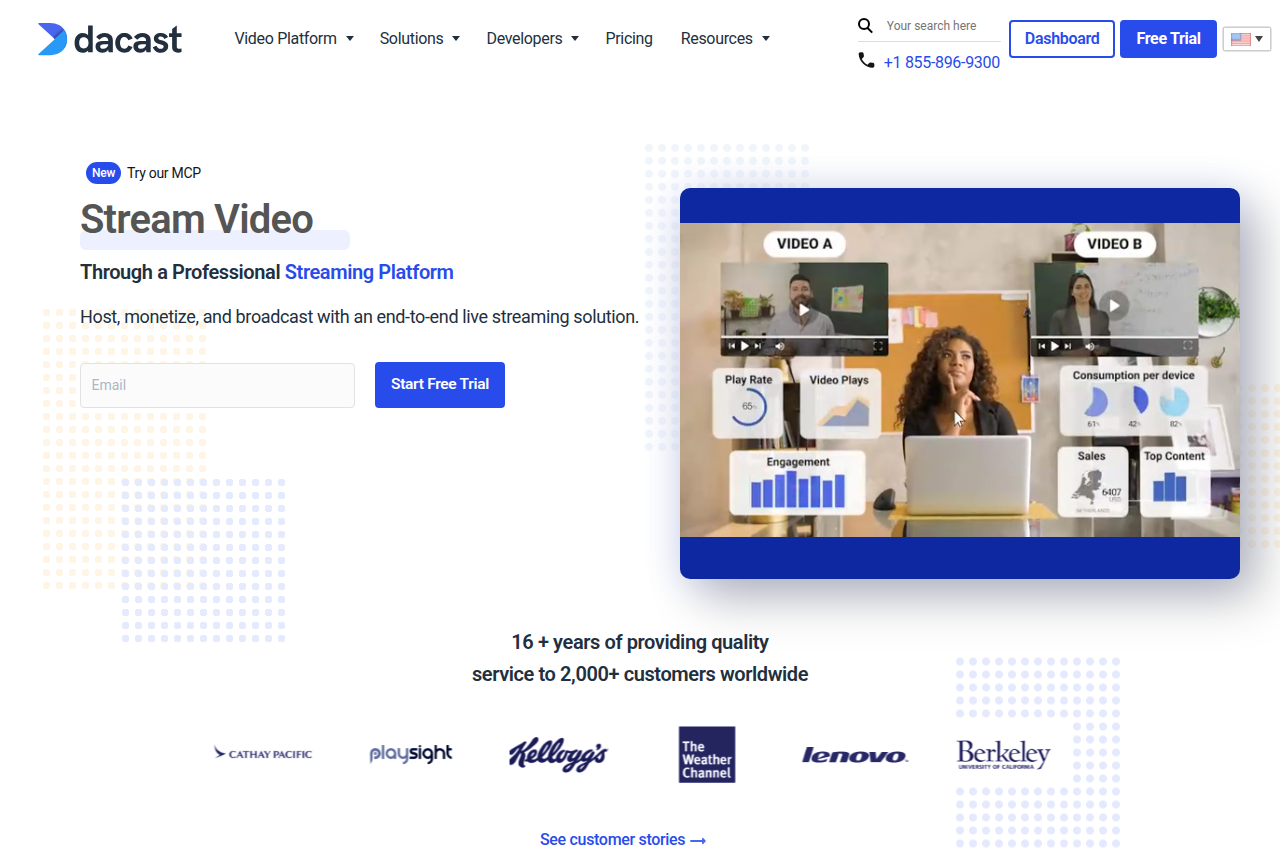
Dacast homepage with the headline "Stream Video Through a Professional Streaming Platform" and a "Start Free Trial" button
Dacast’s homepage, showing its professional live streaming and video hosting platform.

Dacast comes at the same problem from the broadcaster’s side. It is built for live streaming first, with reliable multi-CDN delivery, a paywall for pay-per-view and subscriptions, ad insertion, and DRM and AES protection on the Scale plan. If your Vimeo OTT channel leans on live events, a weekly show, a conference, a sports feed, a church service, this is the platform that treats that as the main event rather than an Enterprise add-on.

The pricing model is the real difference, and it cuts both ways. Dacast sells you a bandwidth and storage allowance (Starter is $39 a month billed annually for 2.4 TB a year and 500 GB of storage; Scale is $165 for 24 TB and 2 TB), with no fee per subscriber. At a few thousand light-viewing members that works out to pennies each, well under Vimeo OTT’s dollar. But a binge-watch catalog burns through the allowance fast, overages run $0.30 per GB of data and $0.15 per GB of storage, and the built-in paywall takes 9.9% plus $0.40 on every purchase. Model your real watch hours before you assume it is the cheaper option.

The honest limit is scope. Dacast is a streaming-infrastructure and live-events tool, not a membership-app builder: its standard plans deliver a web player and a paywall, not native Netflix-style mobile and TV apps, and its community and marketing tools are thin next to a purpose-built membership platform. So if the reason you are leaving Vimeo OTT is precisely to get Roku and Apple TV apps and audience-retention tooling, Dacast solves the streaming half and leaves the membership half to you. There is a 14-day free trial with no card, which makes it cheap to test the fit.

What works

  • Usage-based plans from $39/mo billed annually, cheaper per subscriber than Vimeo OTT once your bandwidth is covered
  • Strong live and pay-per-view event streaming with a built-in paywall, plus DRM and AES on the Scale plan
  • No per-subscriber SaaS fee: you pay for the bandwidth and storage you actually use

What to watch

  • It is a live-broadcast platform, not a membership-app builder: there are no native Netflix-style mobile or TV apps in the standard plans
  • Bandwidth and storage overages ($0.30/GB data, $0.15/GB storage) can dominate the bill on a heavy-viewing catalog, and the paywall takes 9.9% + $0.40 per purchase
  • Community, marketing automation and audience tools are thin next to a purpose-built membership platform

3. TrackPlay, best Vimeo OTT alternative for a paid-traffic VSL

Free plan: 1,000 plays/mo, watermarked. Paid from $29/mo, billed by plays. Visit TrackPlay.

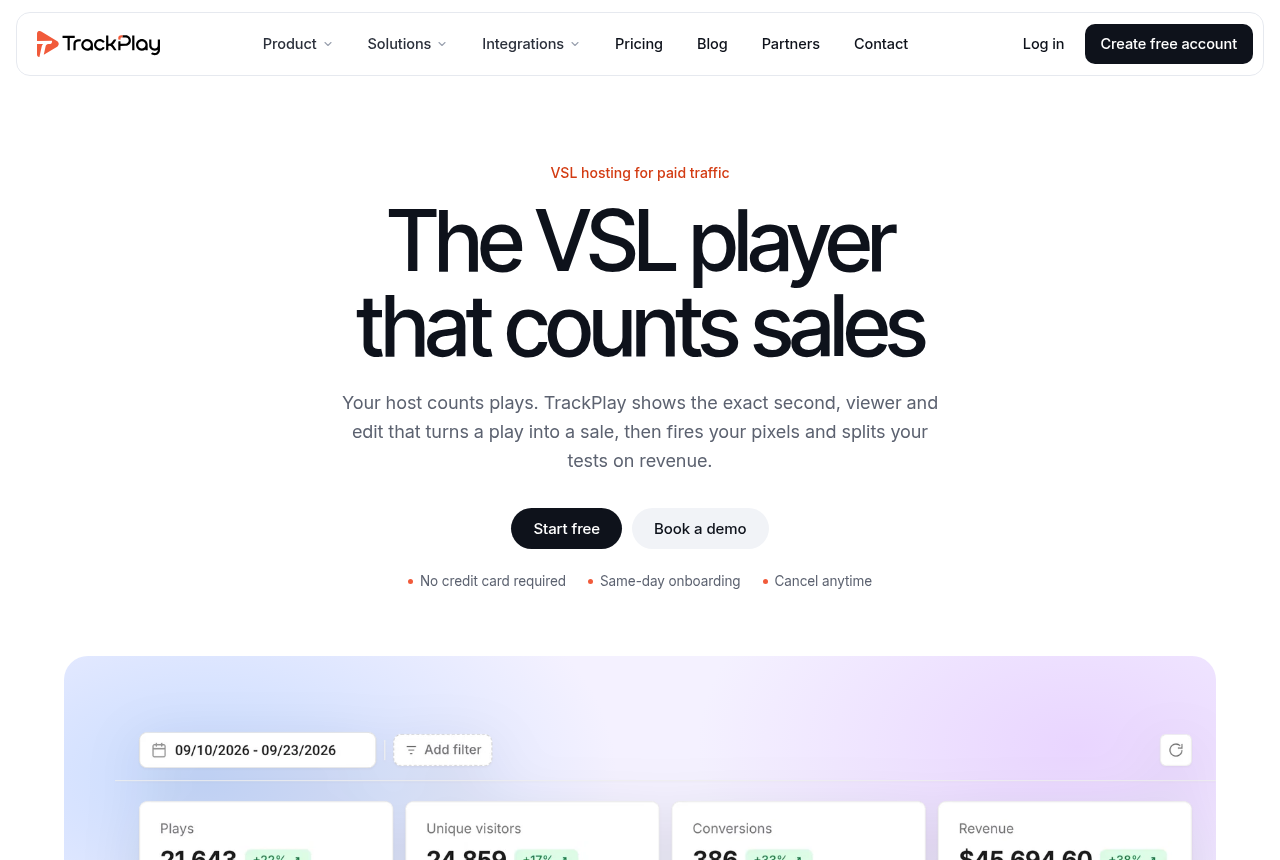
TrackPlay homepage, headline "The VSL player built to convert, not just play", with an "Analytics for paid-traffic VSLs" label and stats for video start time, ad platforms tracked and sound on first impression
TrackPlay’s homepage, a VSL player and analytics platform for paid-traffic funnels.

Every platform above answers how to run a subscription streaming service: a catalog of titles, watched behind a login, ideally on a television. If your video is not a catalog at all but a single recorded sales letter you run paid traffic to, that was never your question, and no OTT platform answers the one that is: which player moves the most sales, and how do you prove which ad bought. TrackPlay is a VSL player and analytics platform built for exactly that. It hosts the recorded video behind one embed that drops into any funnel builder, holds attention with sound-first autoplay and timed CTAs, and draws per-second retention split into buyers and non-buyers, so you can see the seconds to cut and the seconds to protect. What sets it apart is what happens after the play: it decides split tests on the cart-verified sale with real statistics, a z-test with a p-value and a confidence interval, and the cart posts that sale back onto the play that earned it, server-side to Meta, TikTok and GA4, so the ad platform learns from the actual buy rather than a page-load pixel. It bills by plays instead of subscribers or bandwidth, from a no-card free plan of 1,000 watermarked plays a month up to paid plans at $29 a month, with a 14-day trial of the paid features.

Weigh two things honestly before you build on it, and both scope to what TrackPlay is not. It is narrow by design: built for paid-traffic VSL conversion, it is not a general video host or a B2B content library, so it has none of the channels, SEO pages or webinar tooling of a Wistia, and it is the wrong fit when the video’s job is content marketing rather than a direct-response sale. It is also very new, with thin independent validation: the testimonials are on its own site, there is no meaningful third-party review or Reddit footprint yet, and signup is currently invite-only, with the registration page asking for an invitation code, so you cannot lean on outside proof the way you can with a streaming platform that has years of operator threads behind it. That thin track record is what you would expect of a platform this recent, so pilot it on one funnel and reconcile the numbers against your own cart before you trust it with real ad spend.

If that is your job, do not stop at this one name. We rank the whole direct-response field, TrackPlay included, in our best VSL players and conversion video software guide, which is the place to start rather than forcing a recorded sales letter through a platform built to run a subscription catalog.

What works

  • The free plan needs no card and ships every feature, not a cut-down subset: 1,000 watermarked plays a month, a 14-day trial of the paid features, and paid plans that bill by plays rather than subscribers or bandwidth from $29 a month
  • Split tests are decided on the cart-verified sale, with a real z-test, p-value and confidence interval, and every variant runs under one embed so ad links and the campaign’s learning never reset
  • Server-side conversion tracking to Meta, TikTok and GA4 fires on the watch-time milestone you choose and dedupes browser and server events, so the ad platform learns from the actual sale rather than a page-load pixel
  • Cart postbacks tie each sale to the play that earned it from seven direct-response carts, including ClickBank, ClickFunnels and Digistore24, server to server
  • Per-second retention split into buyers and non-buyers, with hook rate, hold rate and revenue per play, so you can see the exact seconds to cut or protect

What to watch

  • It is narrow by design: built for paid-traffic VSL conversion, it is not a general video host or a B2B content library, so it has none of the channels, SEO pages or webinar tooling of a Wistia and is a poor fit if the video’s job is content marketing rather than a direct-response sale
  • It is very new, with thin outside proof: the testimonials are on its own site, there is little third-party review or Reddit footprint yet, and signup is currently invite-only, so you cannot lean on independent validation before you commit paid traffic. That is what you would expect of a platform this recent

4. Muvi One, best Vimeo OTT alternative for white-label

From $399/mo billed annually. White-label web, mobile and TV apps.

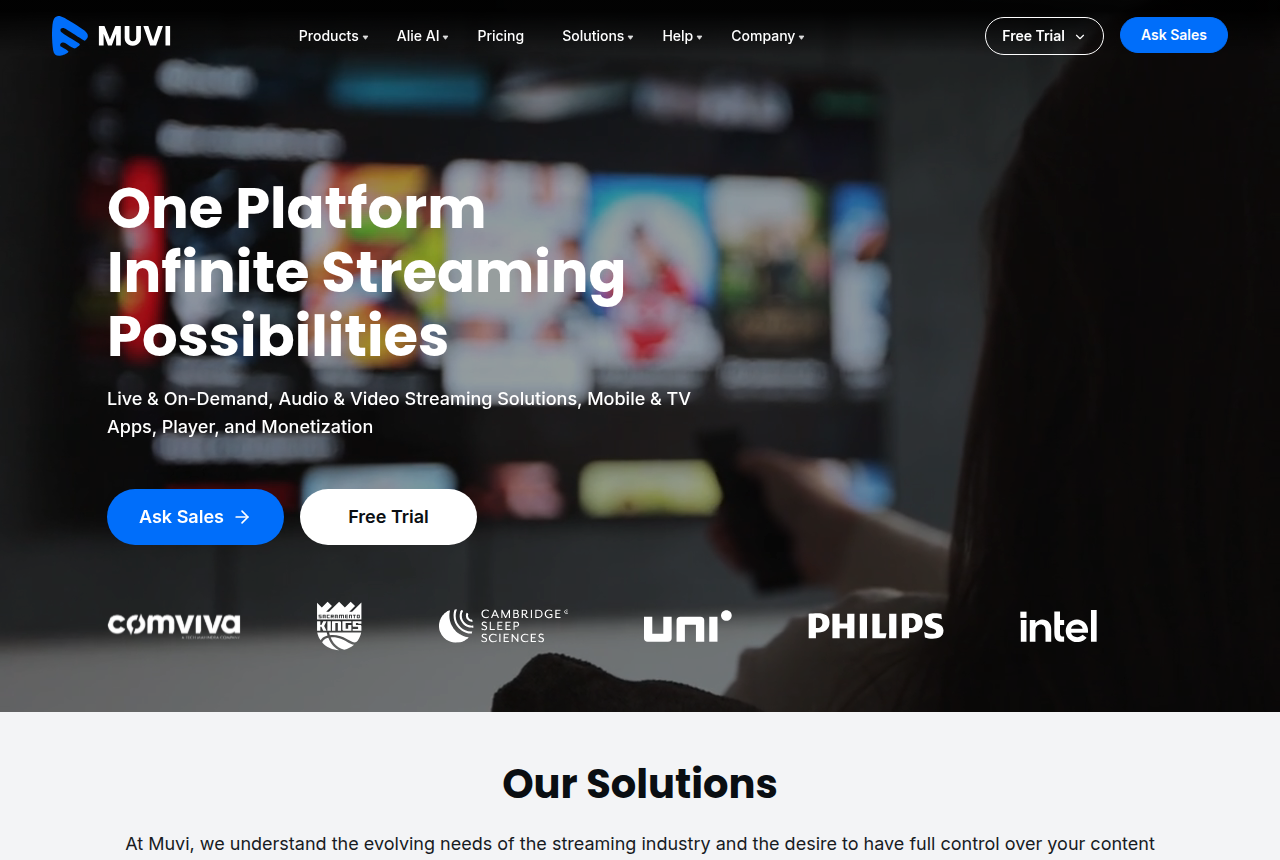
Muvi homepage with the headline "One Platform, Infinite Streaming Possibilities" and Free Trial and Ask Sales buttons
Muvi’s homepage, presenting its no-code, multi-device streaming platform.

Muvi One is the choice when you want to own the whole platform and put your brand, not a host’s, on every screen. It is a no-code builder that ships a fully white-label website plus apps across web, mobile and, at higher tiers, more than ten TV platforms including Roku, Apple TV, Fire TV, Samsung and LG. Every monetization model is built in, SVOD, TVOD and AVOD, alongside DRM, FAST linear channels and multi-currency checkout. In feature breadth it is the platform that most obviously outruns Vimeo OTT Enterprise, and it publishes its tiers instead of hiding them.

It is also the most expensive and the most involved option here. The Standard plan is $399 a month billed annually and includes white-label web and mobile apps, but TV apps only arrive on the $1,499 Professional tier, and Enterprise runs to $3,900. On top of the plan sit variable infrastructure and AI-credit fees, so the sticker price is a floor rather than the whole bill. That is the trade for owning everything: you are running a streaming business with the overhead to match, not renting a simpler product.

Set against the site’s test, whether the platform helps you convert and keep subscribers, Muvi gives you the raw materials (analytics, DRM, every payment model, apps everywhere) but expects you to assemble the growth machine yourself. For a small creator who just wants a paywalled library, that depth is overkill and the price is hard to justify. For an operator with a real content catalog, a budget and a plan to fill ten app stores, it is the most complete answer to Vimeo OTT on this list. There is a free trial with no card and no contract, so you can see the CMS before committing.

What works

  • The widest device coverage here: white-label web, mobile and TV apps across 10+ platforms, built with no code
  • Owns the whole stack (SVOD, TVOD, AVOD, DRM, FAST channels, multi-currency), so you are not boxed into one model
  • Transparent tiered pricing with no revenue share taken from your subscriptions

What to watch

  • Entry is $399/mo and TV apps only start on the $1,499/mo Professional tier, so it is far pricier than Vimeo OTT Starter
  • Variable infrastructure and AI-credit fees are billed on top of the plan, so the sticker price is not the full bill
  • The feature depth is overkill for a small creator who only needs a paywalled video library

5. Kajabi, best Vimeo OTT alternative for coaching

From $143/mo billed annually. Courses, memberships and a branded app.

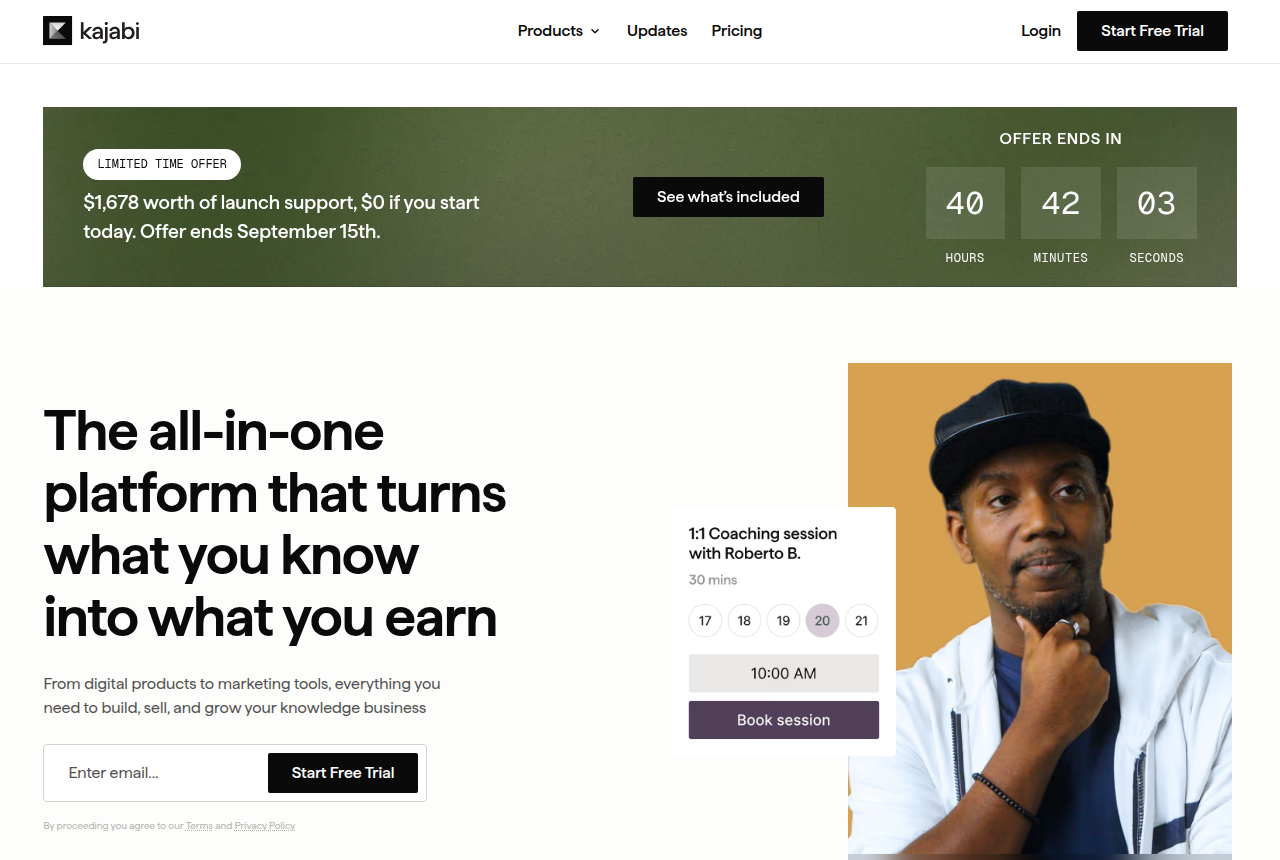
Kajabi pricing page with the headline "One platform. All your business needs." and Basic, Growth and Pro plan cards
Kajabi’s pricing page, showing its Basic, Growth and Pro plans for expert businesses.

A lot of what gets called a streaming service is really a coaching or course business with video attached, and for that, Kajabi is a better fit than any OTT platform. It puts the video inside a full stack, courses, memberships, a community, email marketing, funnels and checkout, so the content sits in a business rather than a bare player. If your Vimeo OTT channel is a fitness program, a training library or a membership around your expertise, Kajabi replaces both the video host and the half-dozen marketing tools around it.

Pricing is published and predictable: Basic is $143 a month billed annually, Growth $199, and Pro $399, with no revenue share when you use Kajabi Payments (standard card processing still applies). The branded mobile app that makes it feel like a real streaming product is a Pro-tier feature, so budget for the top plan if apps matter. There are no TV apps at any tier, which is the line that separates it from the OTT tools above.

That is the honest boundary. Kajabi is a course and coaching platform, not an over-the-top streaming service: it delivers lessons behind a login on the web and a phone, not a binge-watch catalog on a television, and it does not give you the deep per-title viewing analytics an OTT operator relies on. So it replaces Vimeo OTT only when your audience watches on a laptop and a phone and your revenue comes from programs rather than a channel. Within that boundary it is the most complete business-in-a-box on this page, and there is a 30-day free trial to test it.

What works

  • One system for courses, memberships, email, funnels and checkout, so the video sits inside a business, not just a player
  • A branded mobile app and a community space are built in on higher tiers, aimed at course and coaching delivery
  • Transparent published pricing with no revenue share on Kajabi Payments plans (card processing still applies)

What to watch

  • It is a course and coaching platform, not an OTT service: there are no Roku, Apple TV or smart-TV apps, so it does not replace a TV channel
  • The branded mobile app is a Pro-tier feature ($499/mo monthly, $399 billed annually), so apps cost about what they do elsewhere
  • Video delivery is built for lessons behind a login, not a large binge-watch catalog with deep viewing analytics

How we evaluated these

We do not run these platforms on live subscriber bases, and we do not pretend to. We read each vendor’s own documentation and pricing pages for what a tool is, does and costs, and we read long-term operator reports on Reddit and in review threads for how each holds up once real subscribers and real bandwidth are behind it. The plans, fees and limits in this article were read on the vendors’ own pricing pages on 14 September 2026; streaming pricing changes often, so treat the date as part of the fact, and get a written quote before you commit to anything sold by contact-sales.

Because this is a subscription-business decision, we scored each option on the five things that actually decide it: whether you get native mobile and TV apps or have to negotiate for them; which monetization models are built in (subscriptions, one-time, ads, pay-per-view); whether pricing is published or quote-only; the real, all-in cost once per-subscriber, bandwidth or variable fees are added to the sticker; and whether the platform gives you the community, marketing and analytics that keep churn down, because on a subscription service retention is the number that pays the bills.

TrackPlay, at number three, is not judged on those five OTT criteria, because it is not trying to run a streaming service. It is here for the reader whose video is a paid-traffic sales letter rather than a catalog, so we hold it to the site’s own direct-response rubric instead: per-second retention split by buyer, split tests decided on the cart-verified sale, and conversion attribution posted back to the ad platforms. It ranks above the pure streaming platforms because this site ranks by whether the video moves sales, and that is the one thing it does that they do not. That is the same standard we apply on our main best VSL players ranking.

We rank ordinally and publish no star scores, because a number invites you to argue with the decimal instead of the decision. You can read the full method behind our rankings and how we make money.

Frequently asked questions

What is the best alternative to Vimeo OTT?
For most people leaving Vimeo OTT, it is Uscreen. It replaces the same job, a paid subscription video service with a Netflix-style catalog, and adds the parts Vimeo puts behind a sales call: your own iOS and Android apps, a community space, live streaming and marketing tools, all with published pricing from $49 a month. Dacast is the better pick if you run live and pay-per-view events, Muvi One if you want a fully white-label platform with the widest TV-app coverage, and Kajabi if your streaming service is really a coaching or course business.
Why do people leave Vimeo OTT?
Three reasons come up repeatedly. Price: the Starter plan is a clean $1 per subscriber a month, but the apps, live pay-per-view, ad monetization and dedicated support most operators want are only on the Enterprise plan, which is quote-only and requires an annual contract. Opacity: operators on Reddit report it is hard to get even indicative Enterprise pricing, and some describe unexpected increases across Vimeo’s wider plans. Stability: Vimeo agreed to be acquired by Bending Spoons in September 2025, which left some buyers unsure where pricing goes next.
How much does Vimeo OTT actually cost?
The Starter plan is $1 per active subscriber a month plus 10% of one-time (TVOD) purchases and a $0.50 fee per transaction, with bandwidth included. Vimeo’s own help center notes the $1 subscriber fee applies even to subscribers on a 100%-off promo, though not to users still in a free trial. Apps, live linear channels, AVOD, FVOD, DRM and migration help all sit on the Enterprise plan, which is priced case by case under an annual agreement. Prices were read on Vimeo’s pricing and help pages on 14 September 2026.
Which Vimeo OTT alternative has its own TV and mobile apps?
Uscreen and Muvi One both ship native apps. Uscreen includes iOS and Android apps on its App Essentials plan ($449/mo billed annually) and adds TV apps on the quote-only Custom plan. Muvi One is the broadest: white-label web and mobile apps from its Standard plan and TV apps across ten-plus platforms from the $1,499 Professional tier. Dacast’s standard plans are a web player rather than app store apps, and Kajabi offers a branded mobile app but no TV apps.
Is Dacast cheaper than Vimeo OTT?
It can be, but it is priced differently, so the honest answer is "it depends on your viewing." Dacast charges for a bandwidth and storage allowance (from $39 a month billed annually) rather than a fee per subscriber, so at a few thousand light-viewing subscribers it works out to pennies each. But heavy viewing burns through the allowance, and overages run $0.30 per GB, plus the built-in paywall takes 9.9% plus $0.40 on each purchase. Model your real watch hours before assuming it is cheaper.
I just need a video sales letter player, not a streaming service. Is Vimeo OTT the wrong tool?
Yes. Vimeo OTT and the four streaming platforms above are for running a subscription service with many titles behind a login. A video sales letter is a single conversion video on a landing page, and it needs a tool that scores retention second by second, decides split tests on the sale, and fires the conversion back to your ad platform, which an OTT platform does not do. On this page the pick for that job is TrackPlay, at number three: it ties every play to the cart-verified sale and posts it back to Meta, TikTok and GA4. It is very new with thin outside proof, so pilot it on one funnel first. For the wider field, our best VSL players ranking is the place to start.

Sources

Other sources

12 discussions and reviews read for this page. Quotes are excerpts; open a link to read the original in context.

  1. [] Vimeo OTT pricing and plans (vendor) Blog
  2. [] Vimeo OTT pricing breakdown (Vimeo Help Center) Blog
  3. [] Uscreen pricing (vendor) Blog
  4. [] Dacast live streaming pricing (vendor) Blog
  5. [] Do you collect commission on Dacast pay-per-view and subscriptions? (vendor knowledge base) Blog
  6. [] Muvi One pricing (vendor) Blog
  7. [] Kajabi pricing (vendor) Blog
  8. [] TrackPlay: free plan, plays-based pricing and cart-verified attribution (vendor) Blog
  9. [] Vimeo OTT alternatives (r/VIDEOENGINEERING) Reddit
  10. [] Vimeo OTT experience? (r/vimeo) Reddit
  11. [] Frustrated with Vimeo, looking for one unified OTT and membership platform (r/Streaming_Solutions) Reddit
  12. [] Vimeo Enterprise pricing, bandwidth and storage costs (r/vimeo) Reddit

Related reading