Skip to content
Menu

Best VSL players for paid traffic

Video tools ranked for one job: getting more paid traffic past the pitch and proving which traffic buys.

5 tools ranked

By Marcus Vale, Lead reviewer. Reviewed by the VSLBench editorial desk. Last updated 28 September 2026, and rechecked with prices every 90 days.

You are running paid traffic to a video sales letter, and the video is the offer. Meta, TikTok, YouTube or native, it does not matter: the money is decided in the first thirty seconds and again at the pitch, and your only real levers are the player and what it can tell you. So the question is never "where do I put the file". It is "which tool gets more people past the hook and lets me prove which ad, which audience and which creative actually bought".

Most "best video hosting" roundups answer a different question. They rank on picture quality, storage and how the embed looks, then hand the top spot to Vimeo or Wistia for everybody. For a paid-traffic VSL that is the wrong test. Neither of those tools scores a split test on sales, and neither fires a watch-depth pixel back to your ad account, which is the entire game in direct response. A beautiful player that cannot tell you who bought is a liability at scale.

This page ranks five tools through that lens. It states, in money, what each one costs to run rather than to start, because usage is where video bills surprise people. It names the one thing each tool gets wrong. And because the most common follow-up question is a practical one, the choosing section includes exact export steps for the established runner-up, so you are never locked to a player you cannot leave.

Quick answer

TrackPlay is our top pick for most people. TrackPlay is the pick if you run paid traffic to a video sales letter and want the player to prove which traffic, edit and second made the sale. It is a VSL player and analytics platform built for paid-traffic funnels. Sound-first autoplay, timed CTAs and watch gates hold attention; per-second retention split by buyers and non-buyers, revenue per play and conversion funnels show what happened; cart postbacks and server-side events tie the verified purchase back to the play and send it to Meta, TikTok and GA4. Split tests run under one embed and are decided on the cart-verified sale with a p-value and confidence interval. Every feature is included on every paid plan, billing is by plays, and a no-card free plan includes 1,000 watermarked plays a month. The costs are scope and proof. It is narrow by design, not a general host or B2B content library, and it is very new, thinly reviewed and currently invite-only, so pilot one funnel and reconcile its figures against your cart before moving a proven offer.

  • TrackPlay. Best for sales-linked tests. Has a free tier.
  • Vidalytics. Best for mature VSL campaigns. Has a free tier.
  • VTurb. Best for fast VSL builds.
  • Wistia. Best for B2B video. Has a free tier.
  • Vimeo. Best for business hosting. Has a free tier.

How they compare on the numbers that matter

Not resolution or storage. The two columns that decide a paid-traffic VSL are whether the tool can score a split test on sales and whether it attributes revenue to what people actually watched. Prices were read from each vendor's own pages on the dates shown in its review.

Tool From Free plan Sales A/B tests Revenue attribution
TrackPlay $29/mo Yes (1,000 plays/mo, watermarked) Yes, decided on sales Yes
Vidalytics $24/mo Free Forever (3 videos) Yes, native Yes
VTurb Not public Not listed Split tests Limited
Wistia $79/mo Yes (25GB) Views, not sales No
Vimeo $12/seat Yes No No

"From" is the entry price, not the running cost. Vidalytics bills bandwidth beyond your plan at $0.33/GB, and Wistia's lead-gen tier jumps well past its Business plan, so model your real traffic before you compare these straight across.

The players, in detail

Ranked in order of how well each one does the direct-response job, not how polished the marketing site is.

1. TrackPlay, best for sales-linked tests

From $29/mo. Free plan: Yes (1,000 plays/mo, watermarked).
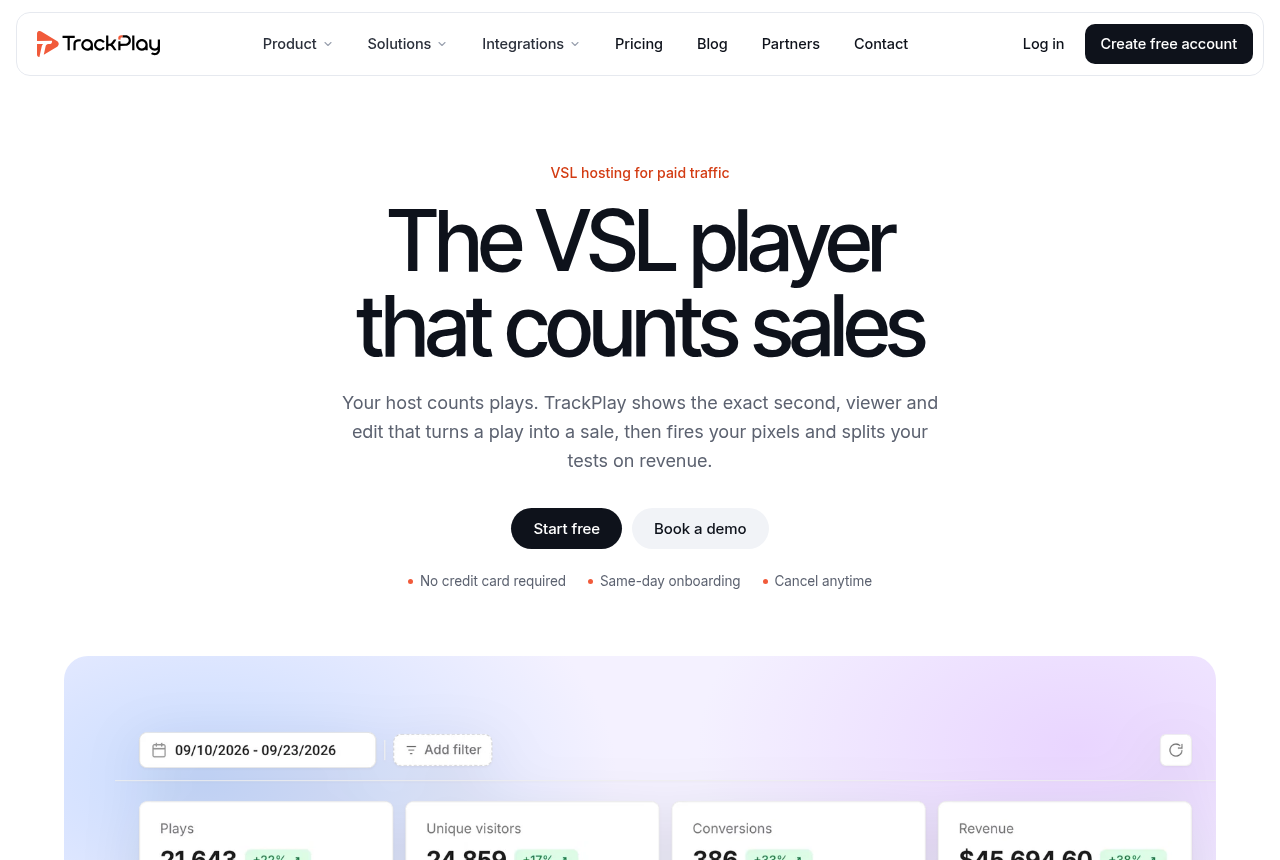
TrackPlay homepage, headed 'The VSL player that counts sales', on its dark hero
TrackPlay, homepage.

TrackPlay is the pick if you run paid traffic to a video sales letter and want the player to prove which traffic, edit and second made the sale. It is a VSL player and analytics platform built for paid-traffic funnels. Sound-first autoplay, timed CTAs and watch gates hold attention; per-second retention split by buyers and non-buyers, revenue per play and conversion funnels show what happened; cart postbacks and server-side events tie the verified purchase back to the play and send it to Meta, TikTok and GA4. Split tests run under one embed and are decided on the cart-verified sale with a p-value and confidence interval. Every feature is included on every paid plan, billing is by plays, and a no-card free plan includes 1,000 watermarked plays a month. The costs are scope and proof. It is narrow by design, not a general host or B2B content library, and it is very new, thinly reviewed and currently invite-only, so pilot one funnel and reconcile its figures against your cart before moving a proven offer.

We break the plans and the long-term user reports down in our full TrackPlay review.

What works

  • Split-test winners are decided on the cart-verified sale with a z-test, p-value and confidence interval, while variants stay under one embed
  • Server-side conversion events go to Meta, TikTok and GA4, and cart postbacks tie the verified sale to the play that earned it
  • Per-second retention separates buyers from non-buyers and reports hook rate, hold rate and revenue per play
  • Sound-first autoplay, timed CTAs and watch gates are built for a paid-traffic VSL
  • Every feature is on every paid plan; billing is by plays, paid plans start at $29 a month and the free plan includes 1,000 plays

What to watch

  • Narrow by design: built for paid-traffic VSL conversion, it is not a general video host or a B2B content library, so it has no channels, SEO pages or webinar tooling and is a poor fit when the video's job is content marketing rather than a direct-response sale
  • Very new, with testimonials on its own site but little independent review or Reddit footprint, and signup is currently invite-only, so pilot it before committing paid traffic
  • Billing is by plays, and a start, unmute, resume and replay can each count, so one viewer may register several plays at volume
  • The contract does not promise a specific uptime percentage, so a proven offer still needs a staged migration and a backup plan

Bottom line: read the TrackPlay review before you commit an offer to it.
2. Vidalytics, best for mature VSL campaigns

From $24/mo. Free plan: Free Forever (3 videos).

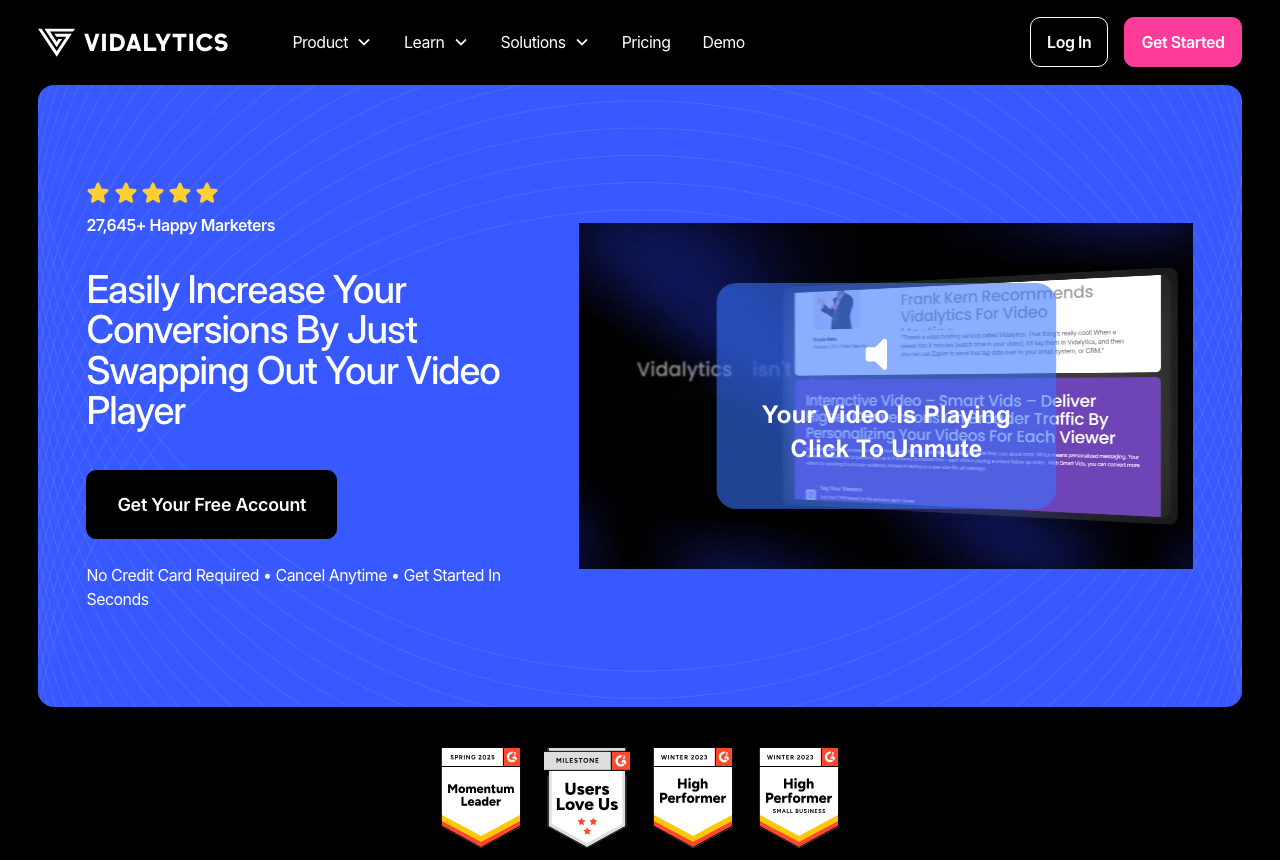
Vidalytics homepage showing its marketing-focused video player and analytics pitch
Vidalytics, homepage.

Vidalytics is the pick if you run paid traffic to a video sales letter and need to score split tests on sales, not views. It is the most complete VSL player of this group for direct response. On the front end you get smart autoplay, resume play, timed CTAs and play gates; on the back end, a second-by-second engagement graph, heatmaps, buyer-versus-non-buyer segmentation, conversion and revenue tracking, and native A/B tests scored on clicks, conversions or revenue. It fires watch-behavior events to Meta and Google for retargeting. There is a Free Forever plan to try it, and paid plans start at $24 a month ($19 billed annually), cheaper to start than Wistia. The catch is bandwidth: paid plans include a monthly allowance and bill overages at $0.33 per GB, so a high-traffic VSL can cost more than the sticker price.

We break the plans and the long-term user reports down in our full Vidalytics review.

What works

  • Purpose-built VSL controls: smart autoplay, resume play, timed CTAs, play gates
  • Second-by-second engagement graph, heatmaps and buyer/non-buyer segmentation
  • Conversion and revenue tracking, plus native A/B tests judged on clicks or sales
  • Free plan to start; paid from $24/mo ($19 billed annually)

What to watch

  • Bandwidth beyond your plan is billed at $0.33/GB, so a high-traffic VSL can outrun the sticker price
  • Smaller independent review base than mainstream hosts, so less third-party proof to check
  • More player and analytics settings than you need if you only want to host and embed a clip

Bottom line: read the Vidalytics review before you commit an offer to it.
3. VTurb, best for fast VSL builds

From Not public. Free plan: Not listed.

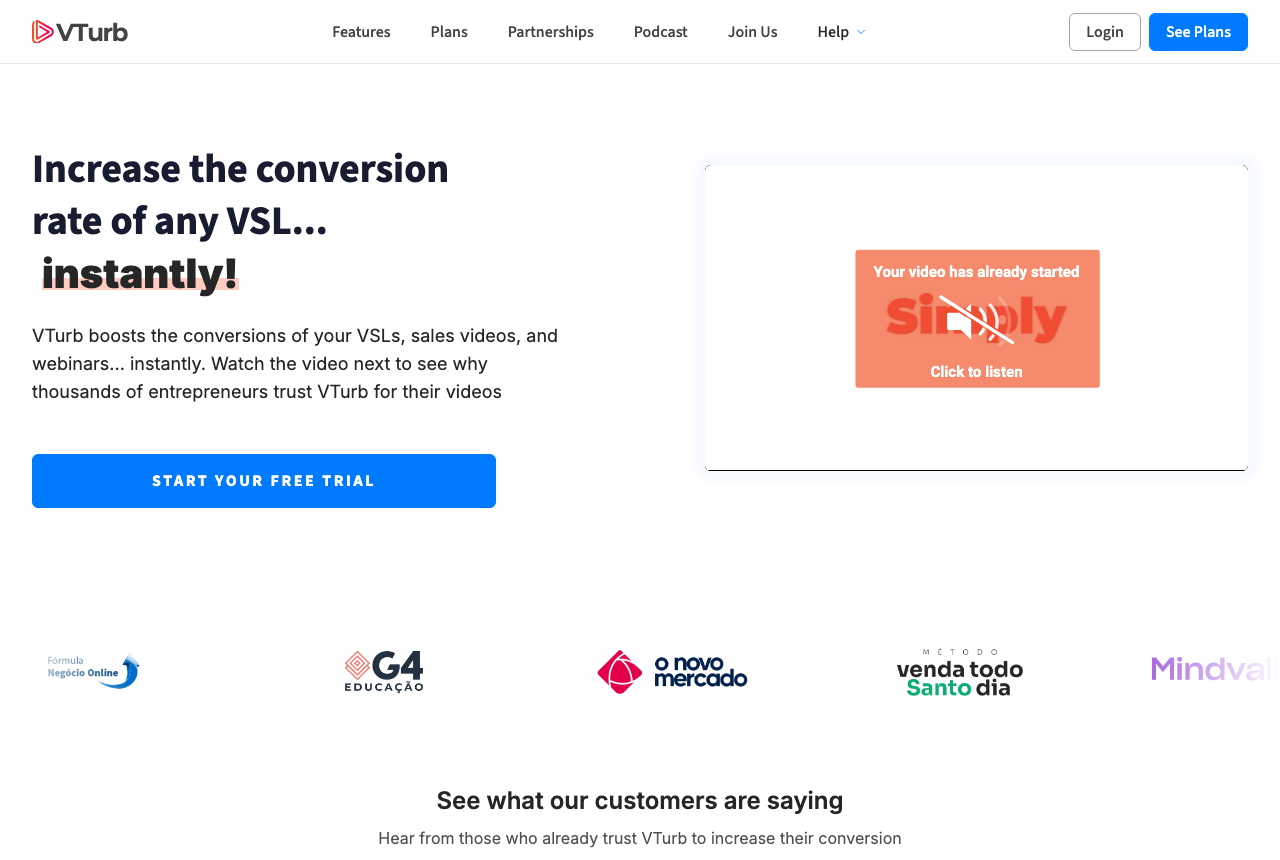
VTurb homepage presenting its smart VSL video player
VTurb, homepage.

A capable smart player built around the VSL: split testing, domain security, playback controls and deep player styling. It is strongest in Latin-American direct response, where it is widely used, and thinner on English-market proof and public pricing. Test it on a non-critical funnel before you move a serious offer, because there is far less independent English-language track record to check than there is for Vidalytics or Wistia.

We break the plans and the long-term user reports down in our full VTurb review.

What works

  • VSL-specific player with smart autoplay and progress controls
  • Split testing and domain security built in
  • Deep player customization

What to watch

  • Public English pricing is not clearly listed
  • Thin English-language review track record
  • Support and docs lean toward the Portuguese-speaking market

Bottom line: read the VTurb review before you commit an offer to it.
4. Wistia, best for B2B video

From $79/mo. Free plan: Yes (25GB).

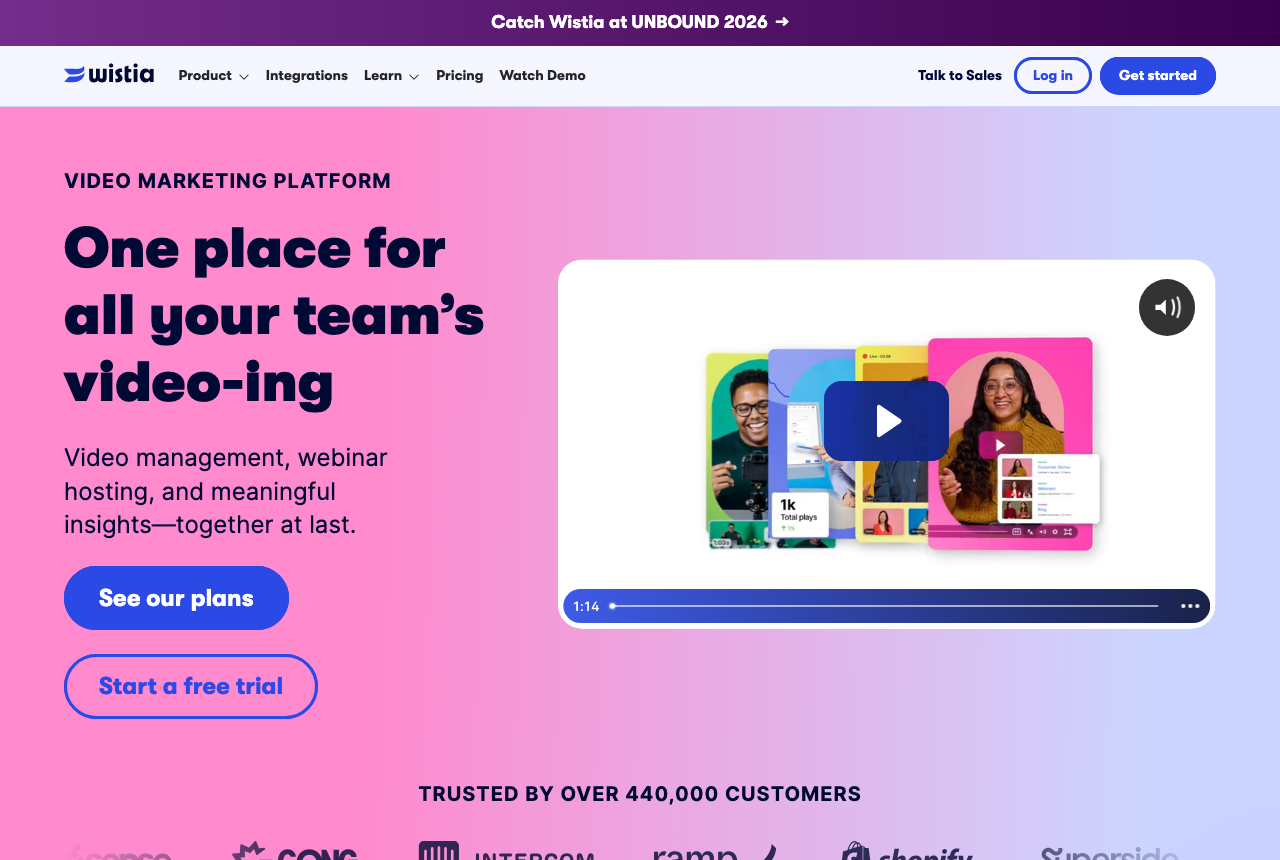
Wistia homepage showing its business video hosting and marketing platform
Wistia, homepage.

The strongest business video platform of the group, but it is built for content marketing and lead gen, not classic VSL funnels. You get branded embeds, CTAs and forms, heatmaps, A/B testing, webinars and real CRM integrations with HubSpot and Marketo. It is overkill and overpriced for a single sales letter: the Business plan is $79 a month and the lead-gen tier jumps to $329, and none of it scores a split test on sales the way a DR player does.

We break the plans and the long-term user reports down in our full Wistia review.

What works

  • Branded, ad-free embeds with forms and CTAs
  • Heatmaps, A/B testing and engagement analytics
  • Real CRM integrations for lead scoring and follow-up
  • Free plan to start

What to watch

  • Built for B2B content, not paid-traffic VSL optimization
  • Business plan $79/mo, Lead Gen tier jumps to $329/mo
  • No sales-scored split testing or cart-level attribution

Bottom line: read the Wistia review before you commit an offer to it.
5. Vimeo, best for business hosting

From $12/seat. Free plan: Yes.

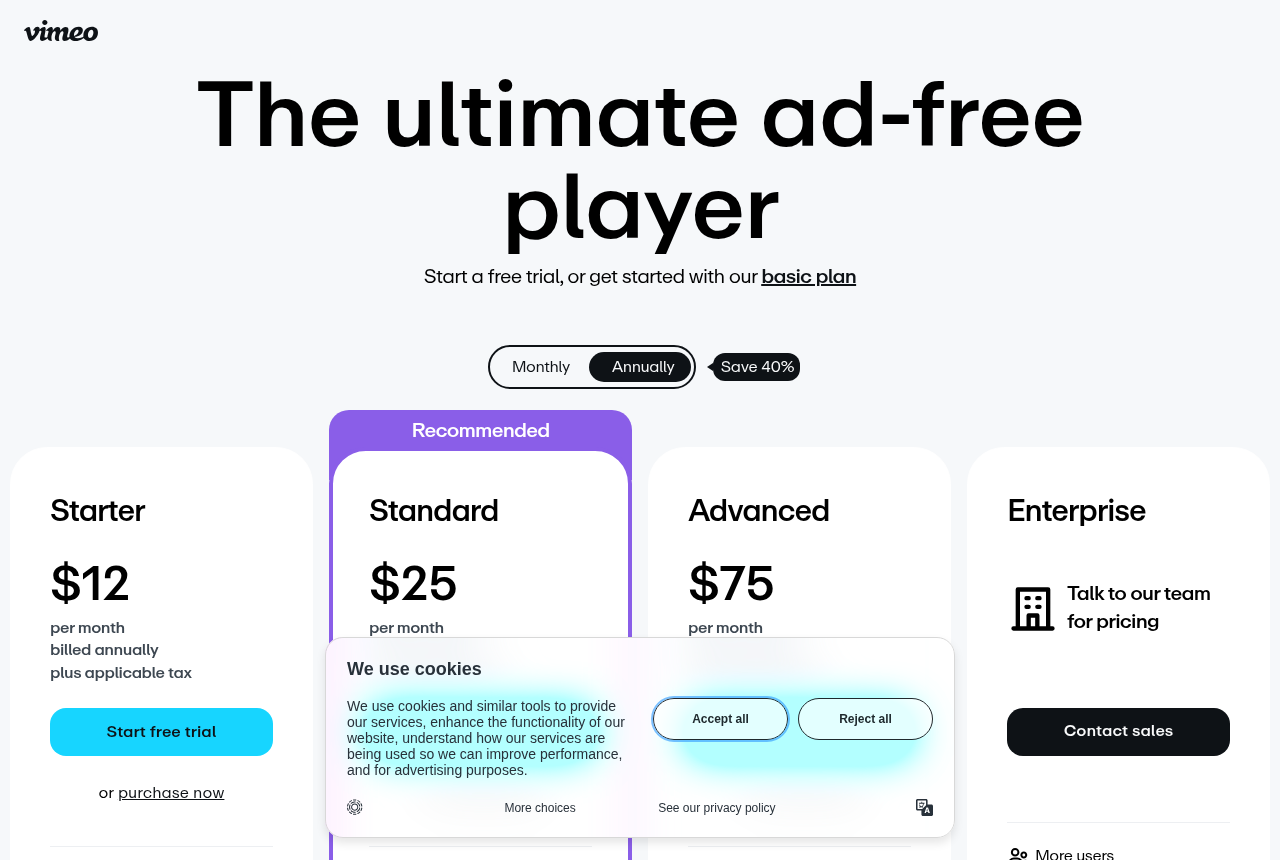
Vimeo homepage showing its professional video hosting and player
Vimeo, homepage.

The simplest pick for ad-free, professional hosting: portfolios, client review, courses and events. It is the wrong main player for a paid-traffic VSL, because the conversion, retargeting and heatmap stack is not there. The entry price looks cheap at around $12 a seat, but bandwidth is capped and 2025-2026 billing changes have bitten people at scale, so check the running cost, not just the sticker price.

We break the plans and the long-term user reports down in our full Vimeo review.

What works

  • Clean, ad-free, reliable hosting
  • Strong client-review and portfolio tools
  • Cheap entry plan and a free tier

What to watch

  • No VSL player controls or sales-focused analytics
  • Bandwidth caps and 2025-2026 billing changes bite at scale
  • Not built to fire watch-depth pixels or attribute revenue

Bottom line: read the Vimeo review before you commit an offer to it.

Winners by segment

The best tool depends on who is running the traffic and what the offer is. Here is the pick and the backup for the four situations that come up most.

Solo direct-response marketer, one VSL, real ad budget

Winner: TrackPlay. It decides the split test on the cart-verified sale, keeps variants under one embed and posts the verified conversion server-side to the ad platforms. It is very new and thinly reviewed, so pilot one funnel first. Runner-up: Vidalytics, if you want the more established direct-response platform and can accept browser-side tracking plus a bandwidth meter.

B2B or SaaS team using video to generate leads

Winner: Wistia. Forms and CTAs in the player, heatmaps, and real HubSpot and Marketo integrations mean the view becomes a scored lead in your CRM. Runner-up: Vidalytics, if the "lead" is really a purchase and you care more about conversion than lead scoring.

Latin-American media buyer

Winner: VTurb. It is widely used in Latin-American direct response, with the player controls, split testing and domain security that market expects, and support in Portuguese. Runner-up: Vidalytics, for the deeper English-language analytics and the larger track record you can check.

You just need clean, ad-free hosting, no sales analytics

Winner: Vimeo. If the video is a portfolio piece, a course lesson or a webinar and you are not optimising a sale around it, Vimeo is the simplest, cheapest professional host. Runner-up: Wistia, when you want branded embeds and light engagement analytics but still no paid-traffic tooling.

What to avoid

YouTube as your VSL host. It is free and it plays everywhere, and it is the wrong tool for a paid-traffic sales letter. It shows related-video recommendations and channel branding, it can serve ads over your pitch, and it hands your buyer a dozen exits at the exact moment you want their attention. It also gives you views, not sales, and no watch-depth pixel to your ad account. Use it for reach, not for a VSL.

Buying on the sticker price and ignoring bandwidth. Every tool here has an entry price that looks fine and a running cost that depends on your traffic. Vidalytics bills overage at $0.33 per GB, Vimeo caps bandwidth and changed billing in 2025 and 2026 in ways that bit people at scale, and Wistia's lead-gen tier is more than four times its Business plan. The number to model is monthly views times video size, not the plan name.

A player you cannot export from. Some hosts make it easy to upload and quietly hard to leave. If a tool has no download or export, every re-edit, every migration and every backup runs through their support queue. Before you commit a serious offer, confirm you can get your own file back out. The choosing section below shows exactly how that works in Vidalytics.

A tool with no track record you can check, on a critical funnel. TrackPlay is the top pick on capability, but it is very new, its outside review record is thin and signup is invite-only. VTurb's English-language review base is thin too. Test either on a non-critical funnel before you move a proven offer onto it. Recommendations that recur across real user reports are worth more than one enthusiastic post.

How we evaluated these

We do not run these tools on live campaigns, and we do not claim to. We read each vendor's own documentation and pricing pages for what a tool is, does and costs, and we read long-term user reports on Reddit, Trustpilot and review sites for how each one holds up once real traffic and real usage are behind it. The plans, fees and limits in this article were checked on the vendors' own pages on the dates shown in each review. Video pricing changes often, so treat the date as part of the fact.

Because this site judges video by whether it moves sales, we scored each tool on five things: whether it can score a split test on sales rather than views; whether it fires watch-behaviour events to Meta and Google for retargeting; the depth of its retention and buyer-versus-non-buyer analytics; the real, all-in cost once bandwidth and overages are added to the sticker; and how easily you can get your own video back out. Picture quality and storage matter, but they are table stakes here, not the ranking.

We rank ordinally and publish no star scores, because a number invites you to argue with the decimal instead of the decision. You can read the full method behind our rankings and how we make money.

How to choose, and how to get your video back out

Work from the job, not the feature list. Three questions settle the choice for almost everyone running paid traffic to a sales letter.

1. Can it score a split test on sales? If you are buying media, you need to know which version of the video made more money, not which one held attention a few seconds longer. Attention and revenue are not the same curve, and only a player built for direct response ties the test to the sale. If the answer is no, the tool is a host, not a VSL player.

2. Can it fire a watch-depth pixel to your ad account? The people who watched to the pitch and did not buy are your best retargeting audience. A tool that can send "watched 60%" back to Meta or Google lets you build that audience automatically. A tool that only reports views inside its own dashboard cannot.

3. What does it cost at your traffic, not at zero? Take your monthly views, multiply by your video's file size, and price the bandwidth. The entry plan is rarely the bill once a campaign scales, and overage rates are where the surprise lives.

Run those three past your situation and the ranking above collapses to one pick. For a solo marketer with real ad spend and a single VSL, that is TrackPlay when you need the test decided on the verified sale and posted back server-side. Its outside proof is thin, so Vidalytics is the established fallback. For a B2B lead-gen motion it is Wistia. For hosting with no sales analytics it is Vimeo. VTurb is the lighter, lower-commitment call while you are still validating an offer.

One question buyers skip until it is too late: can you get your own video back out? A player you cannot export from is a player you are married to, and it turns every re-edit, migration or backup into a support ticket. It is worth checking before you commit, so here are the exact steps for Vidalytics, the established runner-up with documented export steps.

How to download a video from Vidalytics

If the video is hosted in your own Vidalytics account, there is a one-click download built into each video's settings. No third-party tool is needed. The steps, from the Vidalytics knowledge center:

  1. 1

    Log in to Vidalytics and open My Vids, then select the video you want to download.

  2. 2

    Click Edit to open that video's settings page.

  3. 3

    Click the settings (gear) icon in the menu.

  4. 4

    Click the download button. The file saves straight to your device.

Two things to know before you rely on it. First, wait until the red Processing label next to the video title is gone. Vidalytics transcodes every upload and processes the low-quality version first, so a download taken too early can pull a low-resolution copy. Large files can take up to 30 minutes to finish. Second, what you get is a transcoded copy sized for streaming, not the untouched master you first uploaded, because the platform re-encodes video on the way in. If you need the exact source file, keep your own local original rather than counting on a re-download.

If the video is not in your account, for example an embed you found on someone else's landing page, the download button is not available to you. Grabbing the underlying stream with a third-party ripper is a grey area, and you should clear it with the owner before doing it. For your own content, the in-account button is the clean, supported route, and the fact that it exists is one reason Vidalytics does not lock you in the way a player with no export would.

What is a VSL player?

A VSL player is video hosting built around a single conversion video, the video sales letter, rather than around a library of content. It combines two jobs that generic hosts keep separate. The first is playback: a clean, ad-free, brandable player with the controls direct response relies on, such as smart autoplay, resume-play so a returning viewer starts where they left off, timed calls to action, and play gates that reveal a buy button at the point in the pitch you choose.

The second job is the one that defines the category: conversion analytics. A VSL player reports retention second by second, separates the viewing behaviour of buyers from non-buyers, and runs split tests that are scored on clicks, conversions or revenue instead of view count. The best of them fire watch-depth events to ad platforms so you can retarget by how far into the pitch a viewer got, and attribute a sale back to the version of the video that produced it.

That second job is why a marketing host and a VSL player are not interchangeable. A tool like Vimeo hosts the video beautifully and tells you how many people pressed play. A VSL player tells you which traffic, which creative and which cut of the video made the money. For a business that runs paid traffic to a sales letter, that difference is the whole reason the category exists.

Frequently asked questions

What is the best VSL player for paid traffic?
TrackPlay is the pick when the deciding metric is the cart-verified sale. It runs variants under one embed, decides the test on the verified purchase, reports retention by buyers versus non-buyers and posts the conversion server-side to Meta, TikTok and GA4. It is very new and thinly reviewed, so Vidalytics is the more established alternative if independent track record matters more than cart-level attribution.
How do I download a video from Vidalytics?
If the video is in your own account, Vidalytics has a one-click download. Open My Vids and select the video, click Edit to open its settings page, click the settings (gear) icon in the menu, then click the download button and the file saves to your device. Wait until the red "Processing" label is gone before you download, or you may pull the low-quality version.
Can I download the exact original file I uploaded to Vidalytics?
Not necessarily. Vidalytics automatically transcodes every upload so it streams well across devices, so the copy the platform serves and lets you download is a processed version, not your untouched master. If you need the exact source file, keep your own local original rather than relying on a re-download.
Is Wistia or Vimeo a good choice for a video sales letter?
For hosting, yes; for conversion, no. Both play cleanly and look professional, but neither scores a split test on revenue or fires a watch-depth pixel to your ad platform, which is the whole job on a paid-traffic VSL. Wistia is built for B2B content marketing and lead gen; Vimeo is built for clean, ad-free hosting. Use them when the video is not the thing you are optimising a sale around.
Does Vidalytics have a free plan?
Yes. There is a Free Forever plan capped at 3 videos to test the player and the analytics, and paid plans start at $24 a month, or $19 a month billed annually. Prices were read on the vendor pricing page on 14 September 2026.
What does bandwidth actually cost on Vidalytics?
Each paid plan includes a monthly bandwidth allowance, and usage beyond it is billed at $0.33 per GB. On a high-traffic VSL that overage can run past the sticker price, so estimate your monthly views times your video size before you assume the entry plan is your real bill. This is the one number to model before you commit.

Changelog

  • 28 September 2026. Added TrackPlay at number one after checking its cart-verified split testing, server-side attribution, play-based plans and narrow scope; shifted the existing four tools down one place.
  • 14 September 2026. First published. Ranked Vidalytics, VTurb, Wistia and Vimeo on the direct-response rubric, rechecked all prices on the vendors' own pages, and added the step-by-step for downloading your video out of Vidalytics.

Sources

Other sources

8 discussions and reviews read for this page. Quotes are excerpts; open a link to read the original in context.

  1. [] Vidalytics pricing (vendor) Blog
  2. [] How To Download Your Videos (Vidalytics Knowledge Center) Blog
  3. [] Video Transcoding, What to Expect After Uploading (Vidalytics Knowledge Center) Blog
  4. [] Wistia pricing (vendor) Blog
  5. [] Vimeo pricing (vendor) Blog
  6. [] VTurb (vendor site) Blog
  7. [] TrackPlay (vendor) Blog
  8. [] Help downloading vidalytics (r/youtubedl) Reddit

Related reading

Marcus Vale

Written by

Marcus Vale

Lead reviewer

Marcus Vale runs the VSLBench review desk. He has spent years buying paid traffic to video sales letters, and he now reads the player docs, pricing pages and long-term user reports to work out which tools actually move sales instead of just counting views. He writes the player and attribution reviews here, and he is the reason every ranking has to name the tool it is wrong for.

marcus@vslbench.com

Last checked 2026-09-28