Skip to content
Menu

Review

TrackPlay review

A brand-new VSL player that scores split tests on the sale and posts the cart-verified conversion back to your ad platforms. Whether it is real, what it costs once plays add up, and why its thin proof means you pilot it before you trust it.

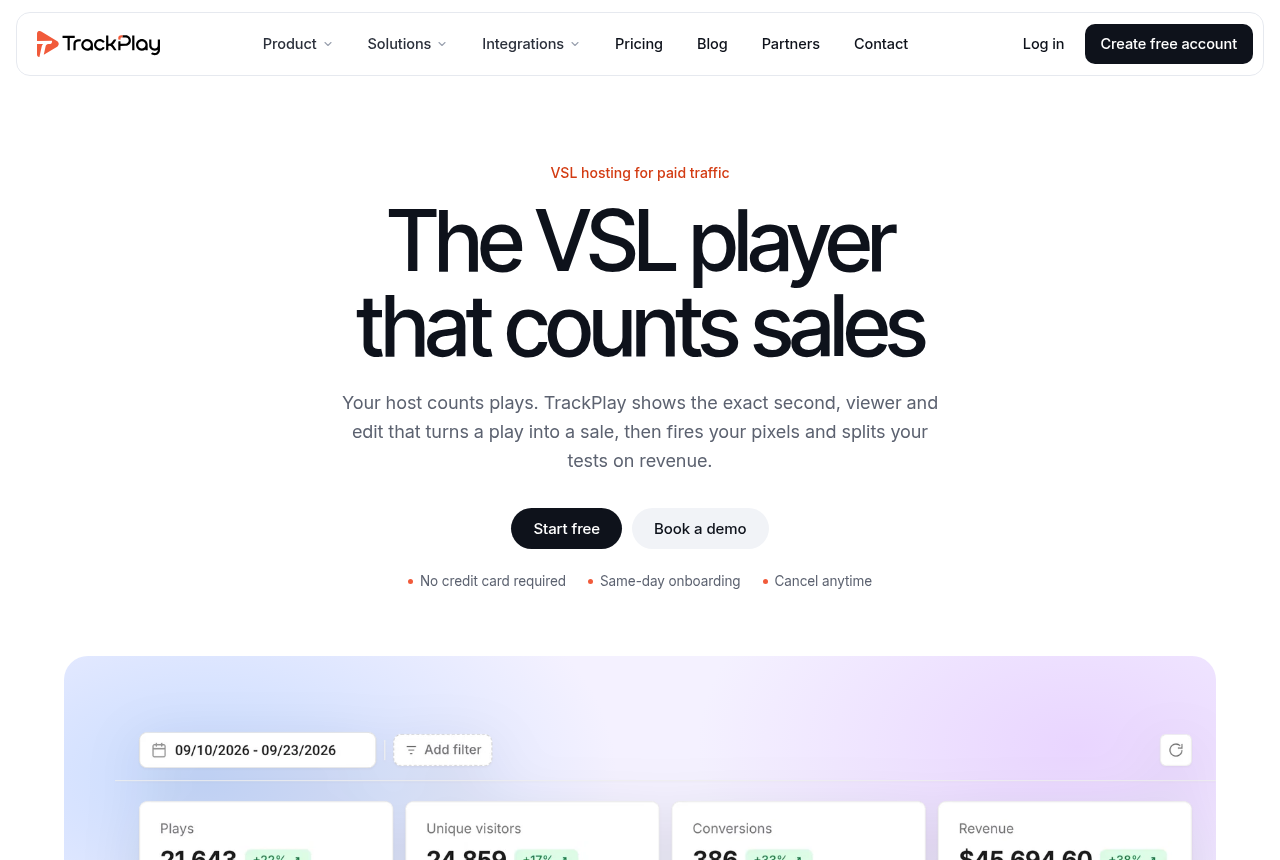
TrackPlay homepage, headed 'The VSL player that counts sales', on its dark hero

By Marcus Vale, Lead reviewer. Reviewed by the VSLBench editorial desk. Last updated 24 September 2026, with prices rechecked every 90 days.

Starts at
$29/mo; a free plan of 1,000 plays, no card
Billing
By plays, every feature on every plan
Sales-scored A/B
Yes, winner decided on the sale
Revenue attribution
Yes, revenue per play with cart postbacks
Server-side pixels
Meta and Google Ads, TikTok, GA4
Independent proof
Thin: launched 2026, on-site testimonials only

Quick answer

TrackPlay is our top pick for most people. TrackPlay is the pick if you run paid traffic to a video sales letter and want the player to prove which traffic, edit and second made the sale. It is a VSL player and analytics platform built for paid-traffic funnels. Sound-first autoplay, timed CTAs and watch gates hold attention; per-second retention split by buyers and non-buyers, revenue per play and conversion funnels show what happened; cart postbacks and server-side events tie the verified purchase back to the play and send it to Meta, TikTok and GA4. Split tests run under one embed and are decided on the cart-verified sale with a p-value and confidence interval. Every feature is included on every paid plan, billing is by plays, and a no-card free plan includes 1,000 watermarked plays a month. The costs are scope and proof. It is narrow by design, not a general host or B2B content library, and it is very new, thinly reviewed and currently invite-only, so pilot one funnel and reconcile its figures against your cart before moving a proven offer.

  • TrackPlay. Best for sales-linked tests. Has a free tier.

You have probably seen TrackPlay in an ad or a marketer's video, promising to show you the exact second your VSL loses the sale, and the question is the honest one: is it real, and will you regret buying it? The short version is that TrackPlay is real. It is a working product from FAIA LLC, a US company, with a live app, published terms, an openly available free plan and paid plans from $29 a month. The regret, when it comes, does not come from the product being fake. It comes from trusting a brand-new tool with a proven offer before you have checked it.

What TrackPlay is is a video player built around one promise most hosts do not make: telling you which traffic actually bought. Its pitch is that your host counts plays while you are left guessing why a VSL converts, so TrackPlay maps every watch session second by second, splits the retention curve into buyers and non-buyers, decides your split tests on the cart-verified sale rather than clicks, and fires your pixels server-side so the ad platform learns from watch behaviour and the real sale. Around that sit the direct-response basics in one embed: Smart Autoplay, timed CTAs, watch gates and lead capture, plus cart postbacks from the direct-response carts a media buyer actually uses, such as ClickBank, Digistore24, BuyGoods, WarriorPlus, JVZoo and Kiwify. It is aimed straight at the job the rest of this site measures tools against.

Where you have to be careful is proof, and cost. It launched in 2026, so its independent track record is almost empty: the testimonials are all on its own site, and there is next to nothing on Reddit or the review sites to weigh against them. And because it bills by plays, and its own terms count an unmute, a resume and a replay as separate plays, the running cost depends on your real traffic more than the sticker suggests. This review is about telling a genuinely on-target product apart from a proven one, and about the exact way to test it before you commit.
What works

  • Split-test winners are decided on the cart-verified sale with a z-test, p-value and confidence interval, while variants stay under one embed
  • Server-side conversion events go to Meta, TikTok and GA4, and cart postbacks tie the verified sale to the play that earned it
  • Per-second retention separates buyers from non-buyers and reports hook rate, hold rate and revenue per play
  • Sound-first autoplay, timed CTAs and watch gates are built for a paid-traffic VSL
  • Every feature is on every paid plan; billing is by plays, paid plans start at $29 a month and the free plan includes 1,000 plays

What to watch

  • Narrow by design: built for paid-traffic VSL conversion, it is not a general video host or a B2B content library, so it has no channels, SEO pages or webinar tooling and is a poor fit when the video's job is content marketing rather than a direct-response sale
  • Very new, with testimonials on its own site but little independent review or Reddit footprint, and signup is currently invite-only, so pilot it before committing paid traffic
  • Billing is by plays, and a start, unmute, resume and replay can each count, so one viewer may register several plays at volume
  • The contract does not promise a specific uptime percentage, so a proven offer still needs a staged migration and a backup plan

What users actually say about TrackPlay

Research: unverified

Built to prove the sale, and the proof is still first party

TrackPlay's pitch and its published testimonials cluster on one idea: deciding split tests on revenue rather than clicks, and firing pixels on watch behaviour so retargeting improves. That is the exact job this site measures tools against. But treat the named quotes as vendor-selected: there is no independent Reddit or review-site record for TrackPlay yet, so a buyer is relying on vendor claims. That is normal for a 2026 launch, and it is the reason to pilot it before moving a proven offer.

“Your host counts plays. TrackPlay shows the exact second, viewer and edit that turns a play into a sale, then fires your pixels and splits your tests on revenue.”

Anonymous Blog: TrackPlay homepage (vendor)

“We split-test on sales now, not clicks. The 'loser' by CTR was the winner by revenue.”

Marcus T. Blog: Vendor-selected testimonial, homepage

“Same video, same traffic, 18% more sales, just from pixels firing on watch time.”

Lena K. Blog: Vendor-selected testimonial, homepage

Billed by plays, and a play is more than a view

TrackPlay bills on plays, and its own terms are blunt that one viewer can register several: a start, an unmute, a resume and a replay can each count. At paid-traffic volume that changes the cost, so model it and use the cap and the live usage dashboard.

“A play is counted when playback starts, when a viewer unmutes, when they resume after a pause, and when they restart the video. So one viewer can register more than one play in a session.”

Anonymous Blog: TrackPlay pricing (vendor)

“A viewer who autoplays a video muted, unmutes it, pauses and resumes, and then replays it counts as four plays.”

Anonymous Blog: TrackPlay Terms of Service (vendor)

No uptime promise in the contract ↓ common complaint

The marketing claims 99.99% uptime, but the Terms of Service decline to promise a specific uptime percentage and provide the service as is. For a high-spend funnel that gap is worth weighing.

“We work hard to keep the player fast and up, and we do not promise a specific uptime percentage in this document.”

Anonymous Blog: TrackPlay Terms of Service (vendor)

What users say

There is not much of a public record yet, and that is the most important thing to say. On its own site TrackPlay publishes named testimonials from marketers, and they are warm and on-message. One offer owner, Marcus T., writes, "We split-test on sales now, not clicks. The 'loser' by CTR was the winner by revenue." A performance marketer, Lena K., says, "Same video, same traffic, 18% more sales, just from pixels firing on watch time." Treat those as vendor-selected: they describe exactly the outcomes the product is built to produce.

The critical side is not an angry review, it is the absence of an independent one. We could not find a Reddit thread or a review-site profile where real buyers argue about TrackPlay's billing, support or whether its attribution numbers hold up. For a 2026 launch that is normal, but it means the glowing quotes have nothing outside the vendor to check them against. The useful, checkable detail is in the fine print instead: the terms spell out that one viewer can count as several plays, and decline to promise a specific uptime figure. None of that says avoid it. It says pilot it, and verify the numbers yourself before you scale spend into it.

Pricing

Prices read on TrackPlay's own pricing page on 24 September 2026. Plans are billed on included plays, not features or seats, and every feature is on every plan, including the free one. Annual billing saves two months.

Plan Monthly Plays / mo What to know
Free $0 1,000 Watermarked, no card, no time limit; playback pauses at the cap, no overage
Basic $29 5,000 First funnels on paid traffic; $0.02 per extra play if you turn it on; 14-day trial
PRO $79 15,000 Marketed as most popular; $0.01 per extra play if you turn it on; 14-day trial
SCALE $199 50,000 High volume; $0.01 per extra play if you turn it on; 14-day trial

Every plan ships the full player and every conversion tool: split testing scored on sales, Meta and Google Ads pixels, cart postbacks, webhooks, the REST API and signed URLs. The number to model is not the sticker, it is plays, because a start, an unmute, a resume and a replay each count, so budget for more than one play per viewer. Leave overage off and playback simply pauses at your cap. Above 50,000 plays a month is a custom quote.

Changelog

  • 24 Sep 2026 — First published. Read TrackPlay's own homepage, pricing and terms pages for what it is, what it costs and how plays are billed, confirmed the FAIA LLC operator and the 2026 launch, searched for and did not find an independent review or Reddit record, captured the homepage, and verified the plan prices shown.

Frequently asked questions

Is TrackPlay legit, or too new to trust?
It is a real, working product. TrackPlay is operated by FAIA LLC, a company registered in Delaware in the United States, with published terms and a privacy policy, a live app, plans billed through the usual card checkout, and an openly available free plan that needs no card. The honest caution is not that it is fake, it is that it is new: it launched in 2026 and there is almost no independent review or Reddit record yet, so treat it as a real but unproven tool and pilot it before you rely on it.
What is TrackPlay actually for?
One job: paid-traffic video sales letters where you need to prove which traffic, edit and second made the money. It scores split tests on the cart-verified sale, draws per-second retention split by buyers versus non-buyers, and fires server-side pixels and cart postbacks so the sale is credited to the play that earned it. It is not a general video host or a content-marketing platform, and it does not stream live.
How much does TrackPlay cost?
There is a free plan with 1,000 plays a month, watermarked, no card and no time limit. Paid plans are Basic $29 a month (5,000 plays), PRO $79 (15,000 plays) and SCALE $199 (50,000 plays), with annual billing saving two months (checked 24 September 2026). Every feature is on every plan, including the free one. Plans differ only on how many plays are included and what an extra play costs.
How does play-based billing work, and can it surprise me?
You are billed on plays, and TrackPlay is blunt that a play is more than a view: a start, an unmute, a resume after a pause and a replay each count, so one viewer can register several plays in a session. At paid-traffic volume that changes the math. You can leave overage off, in which case playback pauses at your cap rather than charging you, and usage is live in the dashboard, so model your real traffic before you pick a plan.
Will I regret buying TrackPlay?
Only if you buy it as a proven, battle-tested platform. It is new, its proof is all first-party, and the contract does not promise a specific uptime percentage. The low-regret way in is the one the vendor already offers: start on the free plan or the 14-day trial, run one non-critical funnel, and reconcile its pixel, attribution and play-count numbers against your own cart and ad accounts before you move a proven offer onto it.

Sources

From TrackPlay

Other sources

4 discussions and reviews read for this page. Quotes are excerpts; open a link to read the original in context.

  1. [] TrackPlay homepage (vendor) Blog
  2. [] TrackPlay pricing (vendor) Blog
  3. [] TrackPlay Terms of Service (vendor) Blog
  4. [] TrackPlay Privacy Policy (vendor) Blog

Related reading

Marcus Vale

Written by

Marcus Vale

Lead reviewer

Marcus Vale runs the VSLBench review desk. He has spent years buying paid traffic to video sales letters, and he now reads the player docs, pricing pages and long-term user reports to work out which tools actually move sales instead of just counting views. He writes the player and attribution reviews here, and he is the reason every ranking has to name the tool it is wrong for.

marcus@vslbench.com

Last checked 2026-09-24