Head to head
Vidalytics vs Vimeo
Pick Vidalytics if the video has to sell; pick Vimeo if it just has to be hosted well and cheaply.
You are down to two, and they are not really the same product. Vidalytics and Vimeo both host your video and give you an ad-free player you can embed anywhere, so side by side they can look like rivals. In practice they answer different questions. Vimeo is built to store and show video well and cheaply. Vidalytics is built to make a video sales letter convert, and to prove which part of it did the work.
This site judges video tools through a direct-response lens: does the player move viewers past the pitch, and can you prove which traffic bought. On that test the two split cleanly. If you are buying cold traffic and sending it to a VSL, an advertorial or a webinar replay, Vidalytics was designed for exactly that, with smart autoplay, timed CTAs, play gates, a second-by-second engagement graph and A/B tests scored on sales. If the video is a portfolio piece, a course lesson or a client cut that just needs to look good and load fast, Vimeo does that for a fraction of the price and none of the marketing overhead.
One steer up front, since this site is built for direct-response marketers. Vidalytics is the stronger of these two for a sales letter, and it wins this comparison. But if the deciding factor is proving which paid traffic actually bought, there is a newer specialist that goes a step further than Vidalytics on attribution: TrackPlay, which decides its split tests on the cart-verified sale and posts that conversion back to your ad account server-side. We line it up beside both below and rank it against the field in our roundup.
So the decision is not really "which is better", it is "what is the video for". Below we put the two side by side on price, player controls, analytics and attribution, then say plainly who each one is for.
Quick answer
Pick Vidalytics if you run paid traffic to a video sales letter and need to see where viewers drop, test versions on sales and fire watch events to your ad account; pick Vimeo if you just need clean, low-cost, ad-free hosting for portfolios, courses or client review and the video is not your main conversion tool.
One more option for this site's core reader: if you run paid traffic and want every split test decided on the cart-verified sale and that sale posted back to your ad account server-side, weigh TrackPlay against Vidalytics too. It is the newer specialist built around that attribution, and we compare it beside both below.
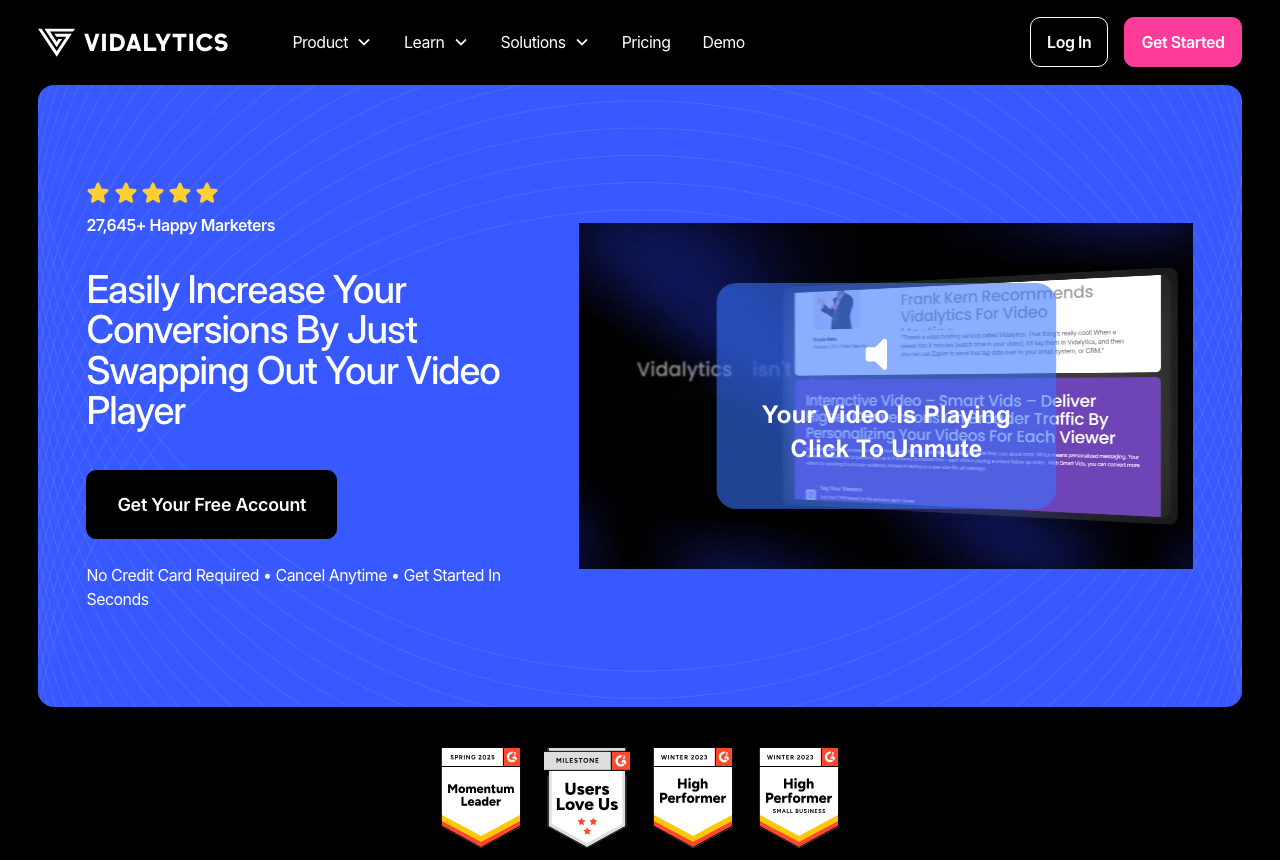
- Vidalytics. Best when the video has to sell. A purpose-built VSL player: smart autoplay, timed CTAs, play gates, a second-by-second engagement graph, heatmaps, conversion and revenue tracking, and A/B tests scored on sales. Free Forever plan, paid from $24 a month.
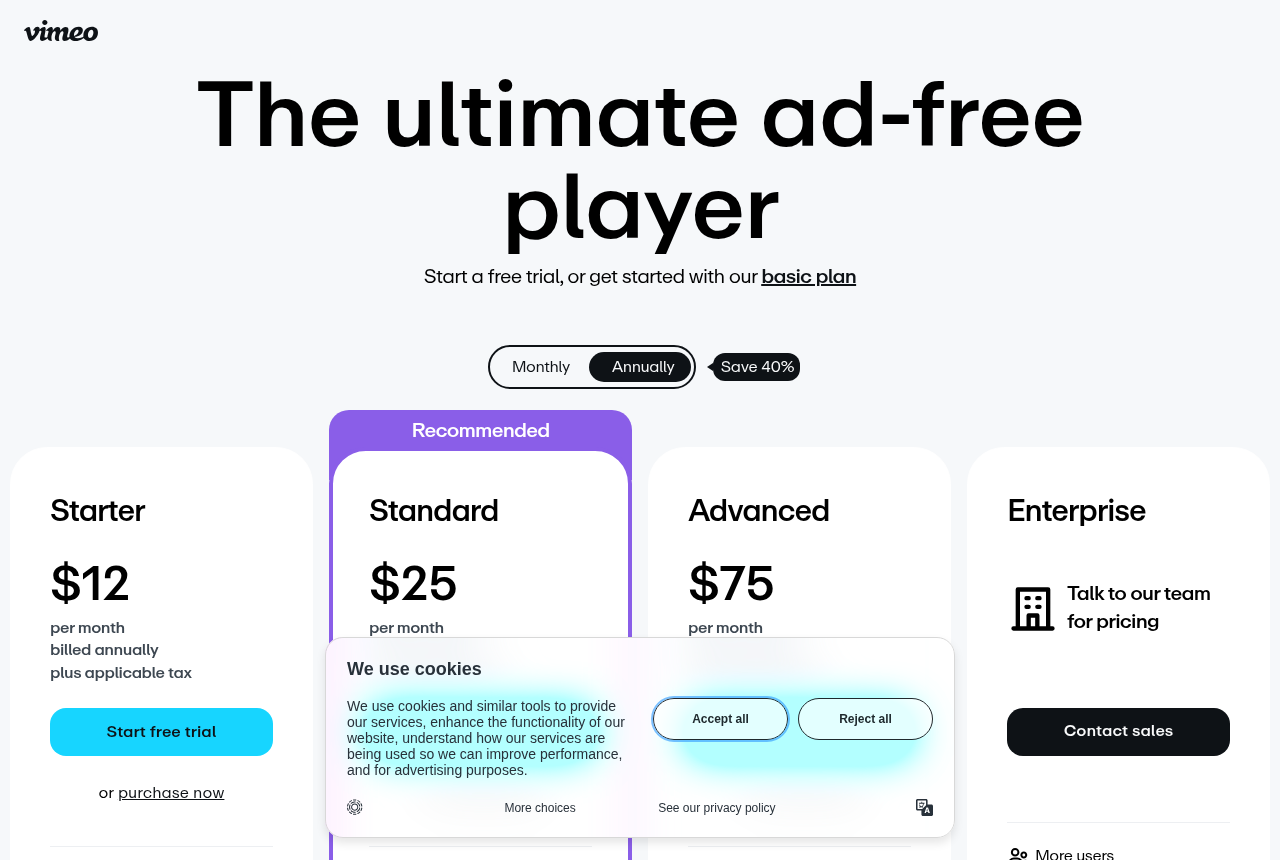
- Vimeo. Best for clean, cheap hosting. Ad-free playback, large storage, and portfolio and client-review tools, from about $12 a seat, with a free tier. No VSL player controls and no sales-scored testing.
- TrackPlay. Best when you need attribution tied to the actual cart-verified sale. Decides split tests on the verified sale with real statistics and fires the conversion server-side to Meta, TikTok and GA4, from $29 a month with a free tier. Not a general host or a webinar tool.
Vidalytics vs Vimeo at a glance
Prices and plan features checked on the vendors' own pages on 14 September 2026. TrackPlay is the direct-response specialist we line these two up against, so it wins the conversion rows and sits out the general-hosting ones.
| Feature | Vidalytics | Vimeo | TrackPlay |
|---|---|---|---|
| Built for | VSLs and video funnels | Hosting, portfolios, courses, client review | Paid-traffic VSL conversion and attribution |
| Starting paid price | $24/mo ($19 billed annually) | About $12/seat/mo (Starter) | $29/mo, all features |
| Free tier | Yes, Free Forever (3 videos, 50 GB) | Yes, limited | Yes, 1,000 plays/mo, watermarked |
| Smart autoplay and resume play | Yes | No | Yes, sound-first autoplay |
| Timed CTAs and play gates | Yes | CTAs and forms on Standard ($25) and up | Yes, timed CTAs and watch gates |
| Second-by-second engagement and heatmaps | Yes (Pro and up) | No, aggregate analytics only | Yes, per second, buyers vs non-buyers |
| Buyer vs non-buyer segmentation | Yes | No | Yes |
| A/B testing scored on sales | Yes (clicks, conversions or revenue) | No | Yes, decided on the cart-verified sale |
| Conversion and revenue tracking | Yes | No | Yes, revenue per play and funnels |
| Watch events to ad platforms | Yes, to Meta and Google | No | Yes, server-side to Meta, TikTok, GA4 |
| Bandwidth model | Plan allowance, then $0.33/GB overage | 2 TB/mo self-serve threshold (Starter) | Billed by plays, not bandwidth |
Strengths and trade-offs
Vidalytics asks you to pay for a marketing player you have to learn; Vimeo asks you to give up knowing what the video did. Those are the two trade-offs.
Vidalytics: what works, what to watch
What works
- Purpose-built VSL controls: smart autoplay, resume play, timed CTAs, play gates
- Second-by-second engagement graph, heatmaps and buyer/non-buyer segmentation
- Conversion and revenue tracking, plus native A/B tests judged on clicks or sales
- Free plan to start; paid from $24/mo ($19 billed annually)
What to watch
- Bandwidth beyond your plan is billed at $0.33/GB, so a high-traffic VSL can outrun the sticker price
- Smaller independent review base than mainstream hosts, so less third-party proof to check
- More player and analytics settings than you need if you only want to host and embed a clip
Vimeo: what works, what to watch
What works
- Clean, ad-free, reliable hosting
- Strong client-review and portfolio tools
- Cheap entry plan and a free tier
What to watch
- No VSL player controls or sales-focused analytics
- Bandwidth caps and 2025-2026 billing changes bite at scale
- Not built to fire watch-depth pixels or attribute revenue
TrackPlay: the paid-traffic VSL pick
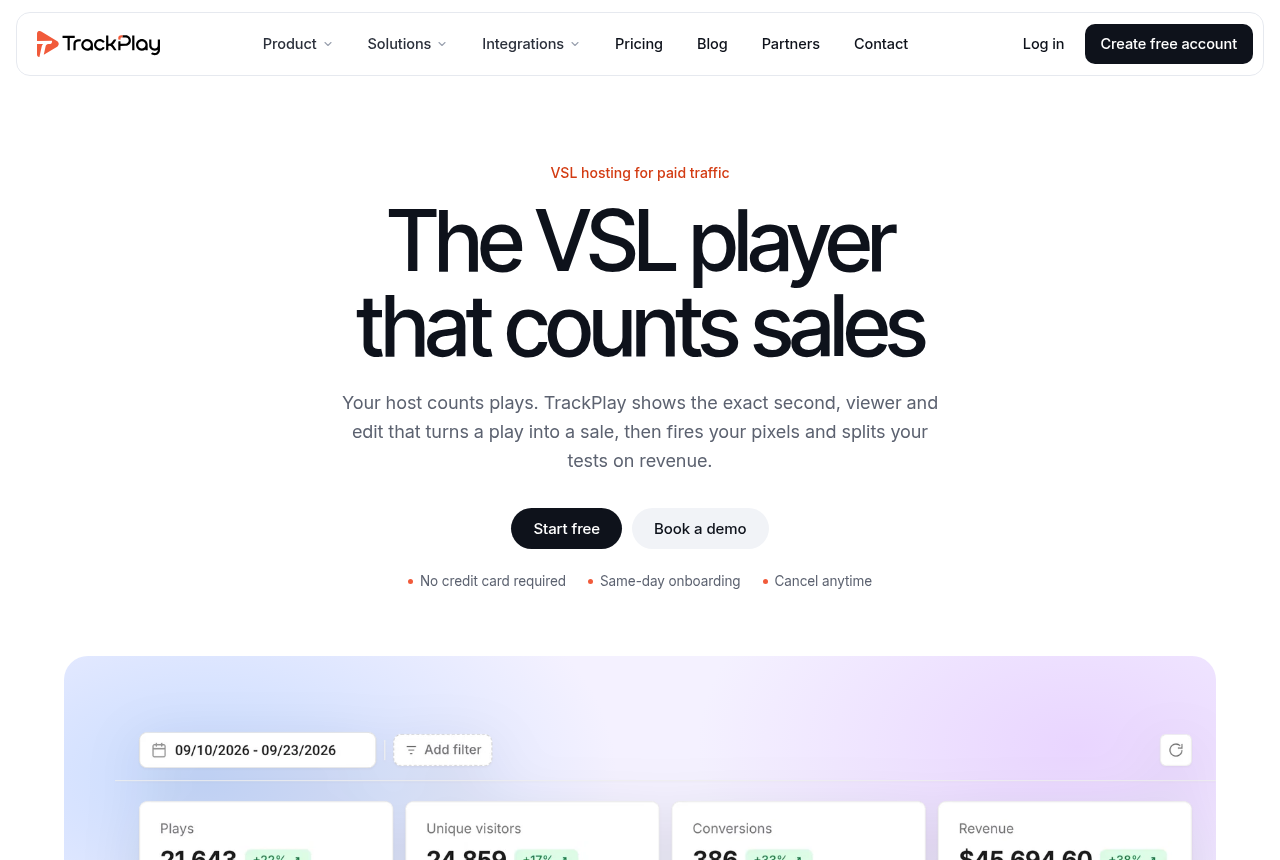
If you reached Vidalytics versus Vimeo because you run paid traffic to a video sales letter, there is a third tool worth putting on the table, and it sits closest to Vidalytics rather than to Vimeo. TrackPlay is a VSL player and analytics platform built for paid-traffic funnels. On the front end it holds attention with sound-first autoplay, timed CTAs and watch gates. On the back end it draws per-second retention split into buyers and non-buyers, with hook rate, hold rate and revenue per play, so you can see the exact seconds to cut or protect. On those player and analytics fundamentals it and Vidalytics do much the same job.
Where it goes further than Vidalytics is attribution. Vidalytics tracks conversions and revenue and can pass watch events to Meta and Google; TrackPlay is built around the cart. The cart posts the verified sale back onto the play that earned it from seven direct-response processors, including ClickBank, ClickFunnels and Digistore24, server to server, and TrackPlay fires that conversion server-side to Meta, TikTok and GA4 so the ad platform learns from the actual sale rather than a page-load pixel. Its split tests are decided on that cart-verified sale with real statistics, a z-test with a p-value and a confidence interval, and every variant runs under one embed so your ad links and campaign learning never reset. It bills by plays rather than bandwidth, every feature ships on every paid plan, and there is a no-card free plan of 1,000 plays a month plus a 14-day trial, with paid plans from $29 a month.
What works
- Split tests are decided on the cart-verified sale, with a real z-test, p-value and confidence interval, and every variant runs under one embed so ad links and campaign learning never reset
- Server-side conversion tracking to Meta, TikTok and GA4 fires on the watch-time milestone you choose and dedupes browser and server events, so the ad platform optimizes on the actual sale rather than a page-load pixel
- Cart postbacks tie each sale to the play that earned it from seven direct-response carts, including ClickBank, ClickFunnels and Digistore24, server to server
- Per-second retention split into buyers and non-buyers, with hook rate, hold rate and revenue per play
- Every feature ships on every paid plan and billing is by plays, with a no-card free plan of 1,000 plays a month and a 14-day trial; paid plans start at $29 a month
What to watch
- Narrow by design: built for paid-traffic VSL conversion, it is not a general video host or a B2B content library, so it has none of the channels, SEO pages or webinar tooling of a Wistia and is a poor fit if the video's job is content marketing rather than a direct-response sale
- Very new, with thin outside proof: the testimonials are on its own site, there is little third-party review or Reddit footprint yet, and signup is currently invite-only, so you cannot lean on independent validation before you commit paid traffic. That is what you would expect of a platform this recent
Where TrackPlay is not the answer
It is narrow by design. TrackPlay is built for paid-traffic VSL conversion, not general hosting, so it is not a video host or a B2B content library and it has none of the channels, SEO pages or webinar tooling of a Wistia. If the video's job is content marketing rather than a direct-response sale, it is the wrong tool: host it on Vimeo, and for marketing video look at Wistia. It is also very new, with thin outside proof: the testimonials are on its own site, there is little third-party review footprint yet, and signup is currently invite-only, which is what you would expect of a platform this recent. If you want an established VSL player with a track record you can read today, Vidalytics is the safer buy. Pilot TrackPlay on one funnel and reconcile the numbers against your own cart before you trust it with a launch.
Visit TrackPlay for the current plans and the free tier.
Pricing, tier by tier
Vidalytics has a Free Forever plan that hosts three videos with 50 GB of monthly bandwidth, a single user and restricted analytics, which is enough to try the player but not to run a funnel. Paid plans, billed monthly, are Starter at $24, Pro at $79 and Premium at $149; billed annually they drop to $19, $63 and $119 a month. Enterprise is custom. Paid plans start a 14-day trial without switching off. The dividing line for direct response is the Pro tier: heatmaps, audience segmentation and conversion tracking begin there, so Starter is really a starter and Pro is the plan most VSL operators actually run.
Vimeo is far cheaper for plain hosting. There is a free tier, then Starter at about $12 a seat a month with 2 TB of storage, Standard at about $25 a seat which adds player-branding removal, custom CTAs and lead-capture forms, and Advanced at about $75 a seat which adds live events. Enterprise is custom. Check the current number before you buy, because Vimeo has changed its plans more than once recently.
TrackPlay prices differently again, because it bills on plays rather than storage or bandwidth. A no-card free plan covers 1,000 plays a month with a watermark, a 14-day trial opens the paid features, and paid plans start at $29 a month with every feature included on every tier. For a single sales letter that undercuts Vidalytics' $79 Pro tier, where the conversion analytics actually live, and it removes the bandwidth-overage risk a high-traffic VSL runs into on Vidalytics' $0.33-per-GB meter. Watch the play count, not a storage cap, as the number that scales your bill.
The sticker price is not the running cost on either side. Vidalytics meters bandwidth: each plan includes a monthly allowance and bills overage at $0.33 per GB, so a VSL taking real paid traffic (and the bots and cheap clicks that come with it) can run past the headline price. Vimeo's self-serve accounts carry a 2 TB per month bandwidth threshold, and its help center says crossing it can prompt Vimeo to move you toward a custom or Enterprise plan. Through 2025 and 2026, Reddit threads have filled with long-time subscribers hit by renewal increases and bandwidth caps, including one titled simply "Stop paying Vimeo after a decade" and another asking whether anyone else is "getting killed by Vimeo's new bandwidth caps". Vimeo also agreed in September 2025 to be acquired by Bending Spoons for $1.38 billion, which has left buyers unsure where pricing goes next.
So the money question is not which is cheaper, because Vimeo plainly is for hosting. It is whether Vidalytics' conversion features earn back the gap. At entry, Vidalytics Pro is $79 against Vimeo Starter at roughly $12 a seat. If the video is a sales letter and you can act on where viewers drop, which hook wins and which watch depths correlate with a purchase, that gap pays for itself in one round of optimization. If the video is only being hosted and embedded, you are paying several times as much for tools you will not turn on, and Vimeo is the rational pick.
The verdict
Between these two, pick on the job. If the video has to sell, Vidalytics wins, and the premium buys the one thing Vimeo cannot give you: proof of what the video did and the controls to improve it. If the video just has to be hosted and look professional, Vimeo wins on price and simplicity, and paying for a conversion stack you will ignore is money lost.
The tie-breaker is honesty about what happens after play. If you can name a click, a lead or a sale the video is supposed to produce, and you want to see and test it, buy Vidalytics. If you cannot, or the video is a portfolio piece or a course lesson, buy Vimeo.
One more call for the reader this site is built for. If you run paid traffic and the deciding question is which ad, which hook and which play produced the actual sale, look past both of these at TrackPlay. Vidalytics tracks conversions and revenue well and passes watch events to Meta and Google; TrackPlay goes a step further and decides each split test on the cart-verified sale, posting that conversion back to Meta, TikTok and GA4 server-side. It is narrow and very new, so pilot it first, but for cart-level attribution it is the specialist we would put beside Vidalytics.
Our pick
Vidalytics
Vidalytics is the pick when the video is doing the selling. Its entry plan costs more than Vimeo's and its independent review base is smaller, but among these two it is the only one built to show where viewers drop, test a VSL on sales and fire watch events to your ad account. Choose Vimeo instead when the video just needs to be hosted well and you would never switch the marketing tools on.
Frequently asked questions
Is Vidalytics or Vimeo better?
Which is cheaper, Vidalytics or Vimeo?
Can Vimeo run a video sales letter for paid traffic?
What if I want attribution tied to the actual sale, not just tracked revenue?
Does Vidalytics have a free plan?
Is it hard to move from Vimeo to Vidalytics?
Is Vimeo still safe to buy after the Bending Spoons acquisition?
Sources
Other sources
10 discussions and reviews read for this page. Quotes are excerpts; open a link to read the original in context.
- [] Vidalytics pricing (vendor)
- [] Vidalytics vs Vimeo (vendor comparison)
- [] Vidalytics for VSLs and video funnels (vendor)
- [] TrackPlay (vendor)
- [] Vimeo pricing plans (vendor)
- [] Bandwidth on Vimeo (vendor help center)
- [] Vimeo to be acquired by Bending Spoons for $1.38B (vendor press)
- [] Is anyone else getting killed by Vimeo's new bandwidth caps? (r/ycombinator)
- [] Stop paying Vimeo after a decade (r/vimeo)
- [] Vidalytics customer reviews (Trustpilot)