Head to head
Bunny Stream vs Gumlet
Pick Bunny Stream if you want the cheapest delivery and will build the funnel; pick Gumlet if you want pixels, CTAs and DRM baked in without a build.
You are down to two, and they are both budget video hosts, not sales-letter players. That is worth saying first: neither Bunny Stream nor Gumlet will optimize a VSL for you. Bunny is raw video infrastructure. It transcodes your upload, stores it across a global network, plays it back through a fast, customizable HLS player, and bills you by the gigabyte. Gumlet is a branded host with a marketing layer bolted on: the same reliable delivery, plus retargeting pixels, in-player CTAs, CRM hooks and DRM. On a price grid Bunny looks cheaper. On a features grid Gumlet looks richer. Both readings miss the real split.
This site judges video tools through a direct-response lens: does the player move viewers past the pitch, and can you prove which traffic bought. On that test both of these fall short, because neither charts where viewers drop, scores a split test on sales or attributes revenue. So the choice between them is not about conversion measurement, which is absent on both sides. It is about how much of the funnel you want handed to you versus how much you are willing to build, and how cheaply you can move bytes at scale.
Framed that way the decision is clear. Bunny is the cheapest, most scalable pipe, and it leaves the marketing and the selling to you. Gumlet costs a little more and gives you the marketing pieces out of the box, at the cost of a thinner reliability record. Below we put the two side by side on price, the player, what you have to assemble, and the running cost, then say plainly who each one is for. If the video's real job is to sell to cold paid traffic and prove it, note up front that a purpose-built VSL player beats both, and on this page that is TrackPlay, which we line up beside these two below and rank against the field in our roundup.
Quick answer
Pick Bunny Stream if you want the cheapest, most scalable video delivery and will put your own player and tracking on top; pick Gumlet if you want a branded host that fires Meta and Google pixels, plays in-player CTAs and locks the file with DRM out of the box, without a build.
One caveat before the build-or-buy call: if that video is a paid-traffic VSL, the pick is neither host. That job belongs to TrackPlay, the direct-response specialist we compare beside them below.
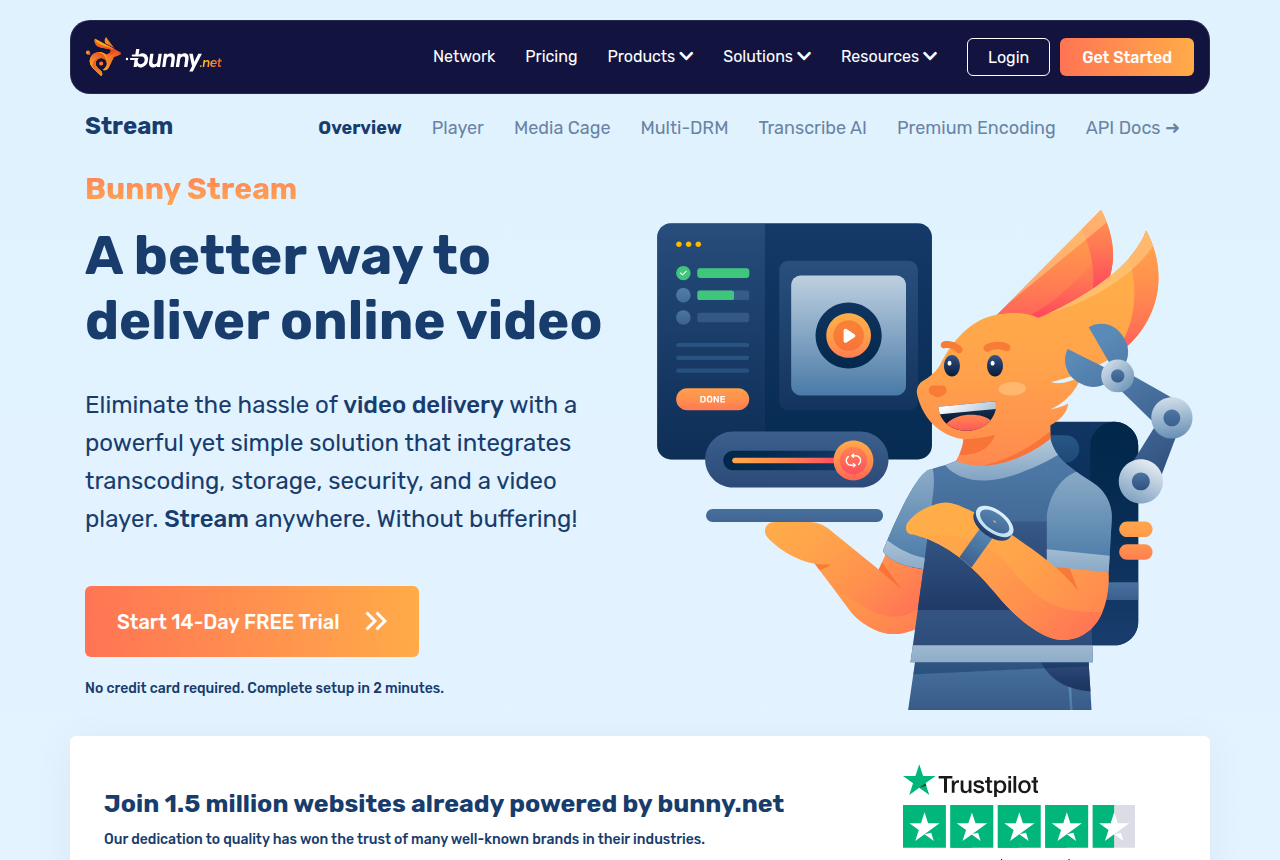
- Bunny Stream. Raw video infrastructure. Transcoding, a customizable HLS player and security are free, and you pay only for storage from $0.01 a GB and delivery from $0.005 a GB. No marketing hooks and no measurement: you wire the CTAs, pixels and tracking up yourself.
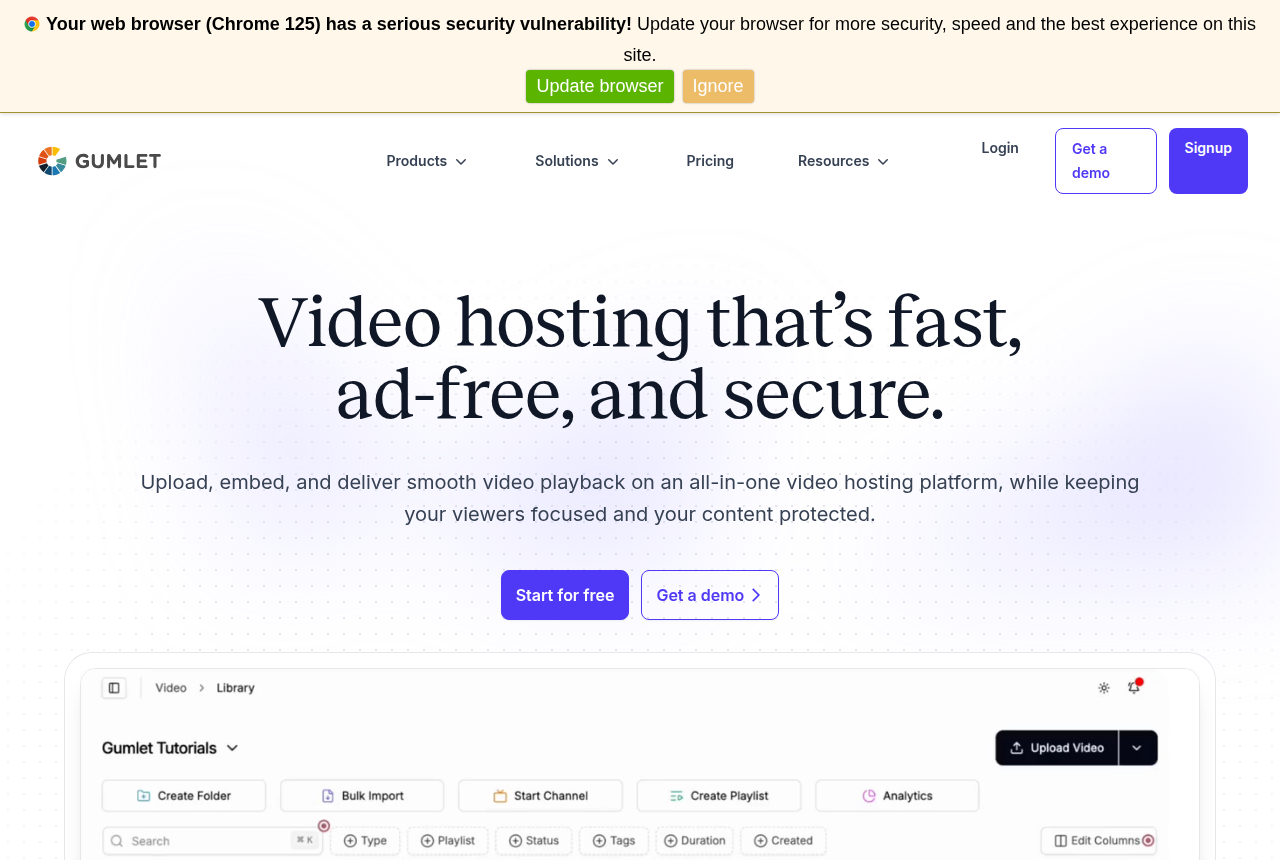
- Gumlet. A branded host with the marketing layer built in. Meta and Google pixel tracking, in-player CTAs and forms, CRM integrations, VAST tags and Widevine and FairPlay DRM, from a Free Forever tier and $6 a month up. It fires the pixel but does not measure retention or attribute revenue.
- TrackPlay. Best when the video is a paid-traffic sales letter. Scores split tests on the cart-verified sale and fires that conversion server-side to Meta, TikTok and GA4, from $29 a month with a free tier. Not a general host, an ad server or a webinar tool.
Bunny Stream vs Gumlet at a glance
Prices and plan features checked on the vendors' own pages on 23 September 2026. TrackPlay is the direct-response specialist we line these two up against, so it wins the conversion rows and sits out the general-hosting ones.
| Feature | Bunny Stream | Gumlet | TrackPlay |
|---|---|---|---|
| What it is | Raw video infrastructure (CDN and player) | A branded host with marketing hooks | A paid-traffic VSL player with attribution |
| Built for | Cheapest reliable delivery, build your own stack | Cheap branded video for courses, e-commerce and SMB | Paid-traffic VSL conversion, no build |
| Starting price | Usage-based, about $1/mo minimum | Free Forever, then $6/mo (Creator, billed annually) | $29/mo, all features |
| Free tier | No, 14-day trial (no card) | Yes, Free Forever (60 storage mins, 100 GB/mo) | Yes, 1,000 plays/mo, watermarked |
| Pricing model | Pay per GB stored ($0.01) and delivered ($0.005) | Fixed tiers, 3,000 GB included, then $0.06 to $0.50/GB | Per play, not bandwidth or storage |
| Player out of the box | Bare customizable HLS, build the overlays | Branded player with in-player CTAs and forms | Sound-first autoplay, timed CTAs, watch gates |
| Google and Meta pixel tracking | No, add your own | Yes (Creator $6 and up) | Yes, server-side to Meta, TikTok, GA4 |
| CRM integrations | No, via your own build | Yes (Growth $19 and up) | Cart postbacks and hot-lead scoring |
| VAST ad tags | No | Yes (Business $99) | No, not an ad-serving tool |
| DRM (Widevine and FairPlay) | No (watermarking, hotlink protection, token auth are free) | Yes ($99/mo add-on) | No, domain-locked hosting instead |
| Conversion measurement | No | No | Yes, per-second retention, revenue per play |
| Delivery network | 250 Tbps, 119 points of presence | Global CDN, adaptive 4K and HDR | Hosted delivery behind one embed |
| Reliability caution | Uneven HLS start-up on some accounts; a thread alleged missing files | Jan 2025 update knocked embeds offline 12h+ for many | Very new, thin outside proof, invite-only |
| Best for | Cheapest delivery at volume, you build the funnel | Cheap branded hosting with pixels and DRM, no build | Paid-traffic VSL conversion and attribution |
Strengths and trade-offs
Bunny asks you to build the marketing layer yourself and to keep your masters backed up; Gumlet asks you to accept that its pixels track viewers but do not prove which traffic bought, and to weigh a reliability wobble. Those are the two trade-offs.
Bunny Stream: what works, what to watch
What works
- Usage-based pricing: encoding, the player and security are free, and you pay only for storage from $0.01/GB and delivery from $0.005/GB
- Fast global delivery on a 250 Tbps network with 119 points of presence
- Customizable HLS player, watermarking, hotlinking protection and token authentication are built in
- Resumable, API-first uploads that pair cleanly with players like Presto Player or Vidstack
What to watch
- No direct-response conversion tools: no sales-scored A/B tests, no watch-depth pixels, no revenue attribution, so a paid-traffic VSL has to add all of that on top
- Long-term users report uneven HLS start-up time and low cache hits on some accounts
- A widely-read thread alleged files disappearing from Bunny Storage, so keep original masters backed up elsewhere
- Usage-based bills scale with traffic, so a viral VSL costs more than the few-dollar examples suggest
Gumlet: what works, what to watch
What works
- Cheapest branded entry point here: a Free Forever tier, then $6/mo (Creator, billed annually) that removes branding and switches on Google and Meta pixel tracking
- Marketing hooks most cheap hosts skip: Meta and Google pixels, CRM integrations, VAST ad tags, and in-player CTAs and forms
- Strong protection for paid content: Widevine and FairPlay DRM, domain and geo blocking, dynamic watermarks and expiring access tokens
- Fast adaptive 4K and HDR playback on a global CDN, with 3,000 GB of bandwidth included on every paid tier
What to watch
- No direct-response conversion measurement: no sales-scored A/B tests, no watch-depth pixel to prove retention, and no revenue attribution, so a paid-traffic VSL cannot prove which traffic buys
- A January 2025 platform update knocked embedded videos offline for many accounts for 12 hours or more, and support reviews are inconsistent, some calling it days-slow
- DRM is a $99/mo add-on on top of the plan, and bandwidth and storage overages bill per GB, so a high-traffic offer outruns the cheap sticker price
- The dashboard has a learning curve and the WordPress and Elementor integrations are less polished than users want
- The third-party review base is thin and aging (Trustpilot sits at 78 reviews, only a handful in the last year)
TrackPlay: the paid-traffic VSL pick
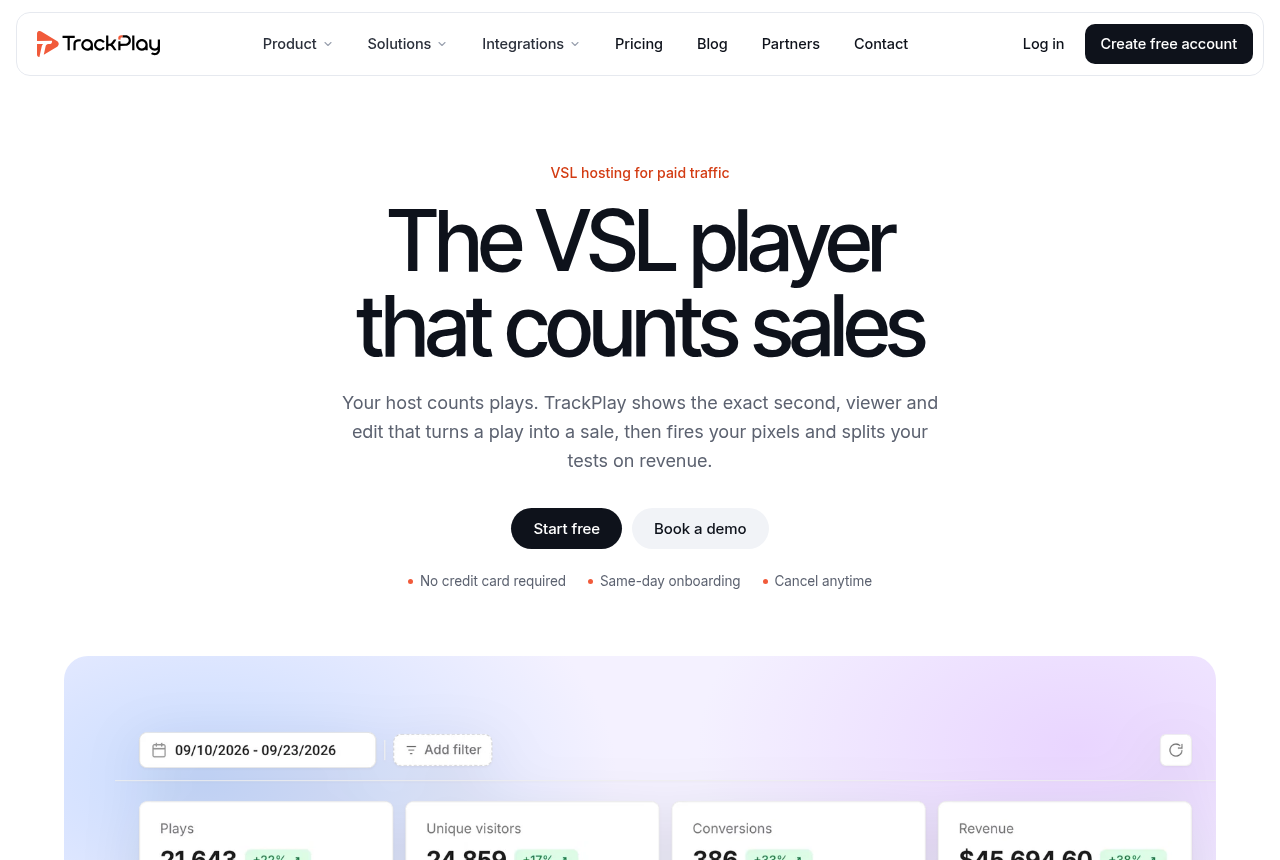
If you landed on Bunny Stream versus Gumlet because you are running paid traffic to a video sales letter, the honest answer is that neither was built for that job and TrackPlay was. It is a VSL player and analytics platform for paid-traffic funnels. On the front end it holds attention with sound-first autoplay, timed CTAs and watch gates. On the back end it draws per-second retention split into buyers and non-buyers, with hook rate, hold rate and revenue per play, so you can see the exact seconds to cut or protect.
What sets it apart from both hosts on this page is attribution. Bunny leaves measurement to you, and Gumlet fires a pixel but stops there; TrackPlay ties the sale to the play that earned it. The cart posts the verified sale back onto that play, and TrackPlay fires the conversion server-side to Meta, TikTok and GA4, so the ad platform learns from the actual sale rather than a page-load pixel. Its split tests are decided on that cart-verified sale with real statistics, a z-test with a p-value and a confidence interval, and every variant runs under one embed so your ad links and campaign learning never reset. It bills by plays rather than gigabytes, every feature ships on every paid plan, and there is a no-card free plan of 1,000 plays a month plus a 14-day trial, with paid plans from $29 a month.
What works
- Split tests are decided on the cart-verified sale, with a real z-test, p-value and confidence interval, and every variant runs under one embed so ad links and campaign learning never reset
- Server-side conversion tracking to Meta, TikTok and GA4 fires on the watch-time milestone you choose and dedupes browser and server events, so the ad platform optimizes on the actual sale rather than a page-load pixel
- Cart postbacks tie each sale to the play that earned it from seven direct-response carts, including ClickBank, ClickFunnels and Digistore24, server to server
- Per-second retention split into buyers and non-buyers, with hook rate, hold rate and revenue per play
- Every feature ships on every paid plan and billing is by plays, with a no-card free plan of 1,000 plays a month and a 14-day trial; paid plans start at $29 a month
What to watch
- Narrow by design: built for paid-traffic VSL conversion, it is not a general video host or a B2B content library, so it has none of the channels, SEO pages or webinar tooling of a Wistia and is a poor fit if the video's job is content marketing rather than a direct-response sale
- Very new, with thin outside proof: the testimonials are on its own site, there is little third-party review or Reddit footprint yet, and signup is currently invite-only, so you cannot lean on independent validation before you commit paid traffic. That is what you would expect of a platform this recent
Where TrackPlay is not the answer
It is narrow by design. TrackPlay is built for paid-traffic VSL conversion, not general hosting, so it is not a raw delivery pipe like Bunny or a branded course host like Gumlet, and it has none of the channels, SEO pages or webinar tooling of a Wistia. If the video's job is content marketing rather than a direct-response sale, it is the wrong tool, and Gumlet's branded host or a marketing platform like Wistia is the better pick. It is also very new, with thin outside proof: the testimonials are on its own site, there is little third-party review footprint yet, and signup is currently invite-only, which is what you would expect of a platform this recent. Pilot it on one funnel and reconcile the numbers against your own cart before you trust it with a launch.
Visit TrackPlay for the current plans and the free tier.
Pricing, tier by tier
Bunny does not sell plans. You pay for what you use, with a $1 monthly minimum, and the player, transcoding and security features are all free. Storage is billed from $0.01 a GB and delivery from $0.005 a GB on the Volume network, or $0.01 a GB on the Standard network in Europe and North America. Bunny's own calculator prices a 300 GB library serving 50 GB a month at about $3.25 to $4.50 before extra replication regions. Every account starts on a 14-day trial with no card.
Gumlet leads with a Free Forever tier: 60 storage minutes and 100 GB of monthly bandwidth on the Gumlet brand. Creator is $6 a month billed annually and is the tier that turns Gumlet from a host into a marketer's tool, removing the branding and switching on Google and Meta pixel tracking. Growth at $19 adds CRM integrations, and Business at $99 adds VAST ad tags, a dynamic watermark and H.265. Every paid tier includes 3,000 GB of bandwidth. Two costs sit outside the plan: DRM with Widevine and FairPlay is a separate $99 a month add-on, and streaming overage bills at $0.06 to $0.50 a GB. Gumlet cut prices by around 30 percent in a May 2026 update, so check the current number before you buy.
TrackPlay meters differently again, by plays rather than gigabytes. A no-card free plan covers 1,000 plays a month with a watermark, a 14-day trial opens the paid features, and paid plans start at $29 a month with every feature included on every tier. For a single sales letter that sits just above Bunny's few-dollar delivery bill and above Gumlet's $6 Creator plan, and what the difference buys is the one thing neither of them does: proving which paid traffic bought. The number that scales the bill is the play count, not a bandwidth or storage cap.
The running cost is where the two hosts separate, and it depends on what you are counting. For raw delivery Bunny is an order of magnitude cheaper per gigabyte, and its bill scales smoothly with traffic, which matters when paid media sends a flood of clicks, bots and cheap traffic at your video. Gumlet's 3,000 GB included per paid tier is generous for a modest branded library, but its overage runs $0.06 to $0.50 a GB, well above Bunny's rate, and a DRM requirement adds a flat $99 a month on top. So at low volume with the marketing hooks switched on, Gumlet's fixed $6 to $19 can undercut the effort of assembling the same layer on Bunny; at high volume, Bunny's per-GB delivery wins clearly.
So the money question is not simply which is cheaper, because it depends on volume and on how you value the built-in marketing layer. Bunny's few-dollar bill buys delivery and nothing else, so getting pixels, CTAs and DRM means building them, usually by putting Presto Player or Vidstack in front of it and wiring your own tracking. Gumlet's $6 to $19 buys those pieces finished. If you or a developer will do the build and traffic is high, Bunny is far cheaper for what a paid-traffic offer actually consumes. If you want the marketing hooks out of the box and your library is modest, Gumlet's low fixed price is the rational pick.
The verdict
Between these two, pick on whether you will build. Neither is a conversion tool, so the tie-breaker is not who measures the sale, because neither does. It is how much of the funnel you want handed to you and how cheaply you need to move bytes. Gumlet gives a marketer the paid-traffic pieces without a build: retargeting pixels, in-player CTAs and DRM, live for $6 to $19 a month. For a non-technical operator who is down to these two, that finished marketing layer is worth more than Bunny's lower per-gigabyte rate, which is why Gumlet wins here.
Bunny is the better pick the moment a developer is in the room or the traffic is heavy. It is the cheapest, most scalable delivery of the pair, it bills per gigabyte with no plan wall, and it pairs cleanly with a player like Presto Player or Vidstack once you are willing to assemble the marketing layer yourself. The trade you accept for Gumlet's convenience is a thinner reliability record, including a January 2025 outage that took embeds offline for many accounts. Whichever way you go, keep your original files backed up and test on a non-critical embed first, and remember that if the video's job is to sell and prove it, a purpose-built VSL player beats both of these.
There is one exception to that build-or-buy call. This site is built for direct-response marketers, and if the video is a paid-traffic sales letter, neither a raw pipe nor a branded host is the tool for the job. You need a player that scores its split tests on the sale and fires the conversion back to your ad account, and that is the one thing neither Bunny nor Gumlet does. TrackPlay is built for exactly that, so for that reader it wins over both. It is narrow and very new, so pilot it first, but on this page it is the tool made for a sales letter.
Our pick
Gumlet
Gumlet is the pick for the marketer who is down to these two and will not build. Among the pair it is the only one that hands you the paid-traffic pieces out of the box: Meta and Google retargeting pixels, in-player CTAs and forms, and DRM to protect a paid offer, from $6 a month billed annually. Bunny is cheaper per gigabyte and scales more smoothly at high volume, but it is bare infrastructure, so getting the same marketing layer means assembling a player like Presto Player or Vidstack and wiring your own pixels on top. The catch on Gumlet is honest about what it is not: it fires the pixel but does not score a split test on sales, chart second-by-second retention or attribute revenue, so it cannot prove which traffic bought. A January 2025 update also knocked embedded videos offline for many accounts, so test it on a non-critical embed and keep your masters backed up. Choose Bunny instead if you or a developer will build the funnel and want the cheapest, most scalable delivery underneath it.
Frequently asked questions
Is Bunny Stream or Gumlet better?
Which is cheaper, Bunny Stream or Gumlet?
Can either one run a video sales letter for paid traffic?
Do I have to build the marketing layer myself on Bunny?
Does Gumlet's DRM make it the safer pick for a paid offer?
Is either one reliable enough for a revenue offer?
Sources
Other sources
10 discussions and reviews read for this page. Quotes are excerpts; open a link to read the original in context.
- [] Bunny Stream (vendor)
- [] Bunny Stream pricing (vendor)
- [] Gumlet video hosting (vendor)
- [] Gumlet pricing (vendor)
- [] TrackPlay (vendor)
- [] BunnyCDN has been silently losing our production files (r/webdev)
- [] Bunny CDN Stream Extremely Slow (r/webhosting)
- [] "Too unreliable for anything serious" (AppSumo review)
- [] Gumlet reviews on G2
- [] Gumlet on Trustpilot