Head to head
Vimeo vs Bunny Stream
Pick Vimeo if you want a polished no-code host you can embed and forget; pick Bunny Stream if you want the cheapest reliable delivery at volume and will build the rest.
You are down to two, and they are not the same kind of product. Vimeo is a finished host: you upload a file, copy an embed, and a clean, ad-free, branded player is live on your page in minutes, with portfolio, client-review, course and event tools around it. Bunny Stream is video infrastructure. It transcodes your upload, stores it across a global network, plays it back through a fast, customizable HLS player, and bills you by the gigabyte. On a price grid Bunny wins by a mile. That grid is only measuring part of the job.
This site judges video tools through a direct-response lens: does the player move viewers past the pitch, and can you prove which traffic bought. On that test neither of these two passes. Vimeo offers aggregate analytics and, on higher plans, custom CTAs and lead forms, but no per-second retention, no split test scored on sales and no watch-depth pixel to your ad account. Bunny offers none of the conversion layer at all. So if the video's whole job is to sell to cold paid traffic, the honest answer is that a purpose-built VSL player will beat both. On this page that is TrackPlay, which we line up beside the two below and rank against them in our full roundup.
This page is still for the reader who has decided to host on one of these two and wants the better host underneath the funnel. Framed that way, the choice is clear: are you buying a polished pipe you can embed and forget, or the cheapest possible pipe to build on. Below we put the two side by side on price, the player, what you have to assemble, and the running cost at scale, then say plainly who each one is for.
Quick answer
Pick Vimeo if you want a polished, no-code host with a usable branded player out of the box and you will not assemble your own; pick Bunny Stream if you want the cheapest reliable delivery at paid-traffic volume and you will put your own player and tracking on top.
One caveat before the two-way call: if that video is a paid-traffic sales letter, the pick is neither of these hosts. That job belongs to TrackPlay, the direct-response specialist we line up beside them below.
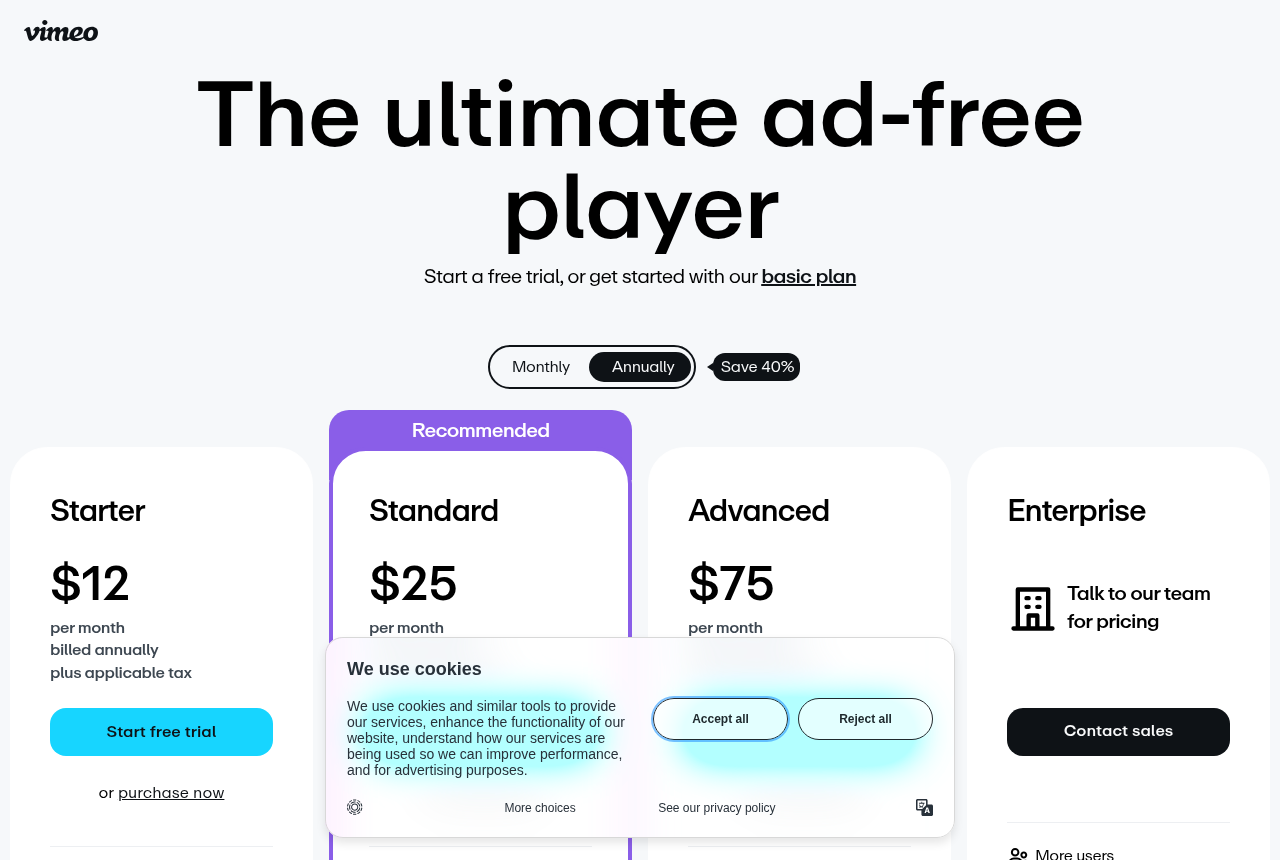
- Vimeo. A finished, no-code host. Upload, grab an embed, and a clean ad-free branded player is live, with portfolio, client-review and course tools around it. Custom CTAs and lead-capture forms arrive on the Standard plan. From about $12 a seat a month, with a free tier. Bandwidth is capped and the plans have moved.
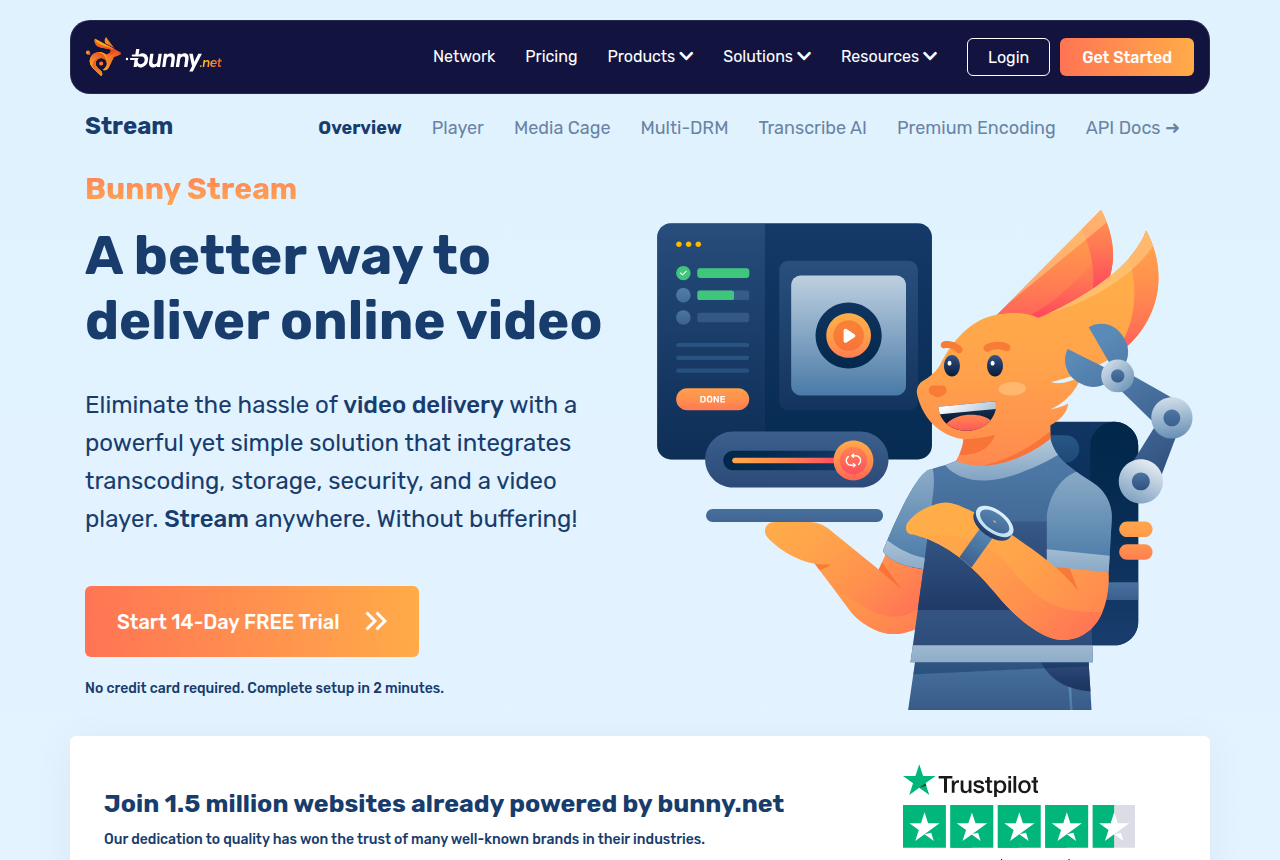
- Bunny Stream. Usage-based video infrastructure. Transcoding, a customizable HLS player and security are free, and you pay only for storage from $0.01 a GB and delivery from $0.005 a GB. There is no packaged conversion layer and no no-code setup: you wire the player and tracking up yourself.
- TrackPlay. Best when the video is a paid-traffic sales letter. Scores split tests on the cart-verified sale and fires that conversion server-side to Meta, TikTok and GA4, from $29 a month with a free tier. Not a general host or a webinar tool.
Vimeo vs Bunny Stream at a glance
Prices and plan features checked on the vendors' own pages on 23 September 2026. TrackPlay is the direct-response specialist we line these two up against, so it wins the conversion rows and sits out the general-hosting ones.
| Feature | Vimeo | Bunny Stream | TrackPlay |
|---|---|---|---|
| What it is | A finished, hosted video platform | Video infrastructure (CDN and player) | A paid-traffic VSL player and analytics platform |
| Built for | Professional hosting, portfolios, courses, client review | Cheap, reliable hosting and delivery | Paid-traffic VSL conversion |
| Starting price | About $12/seat/mo (Starter) | Usage-based, about $1/mo minimum | $29/mo, all features included |
| Free tier | Yes, limited | No, 14-day trial (no card) | Yes, 1,000 plays/mo, watermarked |
| Pricing model | Per-seat plans, 2 TB/mo bandwidth threshold | Pay per GB stored ($0.01) and delivered ($0.005) | Metered by plays, not bandwidth |
| No-code setup | Yes, upload and embed | No, API-first developer setup | Yes, one embed snippet |
| Player out of the box | Branded, ad-free, ready to embed | Bare customizable HLS, build the overlays | VSL player, sound-first autoplay and timed CTAs |
| In-player CTAs and lead forms | Standard ($25) and up | No, build your own | Yes, timed CTAs, watch gates and lead forms |
| Smart autoplay, resume, play gates | No | No | Yes, sound-first autoplay and watch gates |
| A/B testing scored on sales | No | No | Yes, decided on the cart-verified sale |
| Watch-depth pixels to Meta and Google | No | No | Yes, server-side to Meta, TikTok, GA4 |
| Revenue attribution | No | No | Yes, cart postbacks and revenue per play |
| Content security | Domain privacy, password, unlisted links | Free: watermarking, hotlink protection, token auth | Domain-locked video hosting |
| Delivery network | Vimeo's managed CDN | 250 Tbps, 119 points of presence | Managed hosting behind one embed |
| At paid-traffic volume | Crossing 2 TB/mo can prompt a custom or Enterprise plan | Scales per GB, no forced migration | Billed by plays, no bandwidth cap |
| Best for | No-code branded hosting, embed and forget | Cheapest delivery, build your own stack | Paid-traffic VSL conversion |
Strengths and trade-offs
Vimeo asks you to accept a capped-bandwidth plan that has changed under buyers, in exchange for a finished no-code host; Bunny asks you to build the player and tracking yourself, and to keep your masters backed up. Those are the two trade-offs.
Vimeo: what works, what to watch
What works
- Clean, ad-free, reliable hosting
- Strong client-review and portfolio tools
- Cheap entry plan and a free tier
What to watch
- No VSL player controls or sales-focused analytics
- Bandwidth caps and 2025-2026 billing changes bite at scale
- Not built to fire watch-depth pixels or attribute revenue
Bunny Stream: what works, what to watch
What works
- Usage-based pricing: encoding, the player and security are free, and you pay only for storage from $0.01/GB and delivery from $0.005/GB
- Fast global delivery on a 250 Tbps network with 119 points of presence
- Customizable HLS player, watermarking, hotlinking protection and token authentication are built in
- Resumable, API-first uploads that pair cleanly with players like Presto Player or Vidstack
What to watch
- No direct-response conversion tools: no sales-scored A/B tests, no watch-depth pixels, no revenue attribution, so a paid-traffic VSL has to add all of that on top
- Long-term users report uneven HLS start-up time and low cache hits on some accounts
- A widely-read thread alleged files disappearing from Bunny Storage, so keep original masters backed up elsewhere
- Usage-based bills scale with traffic, so a viral VSL costs more than the few-dollar examples suggest
TrackPlay: the paid-traffic VSL pick
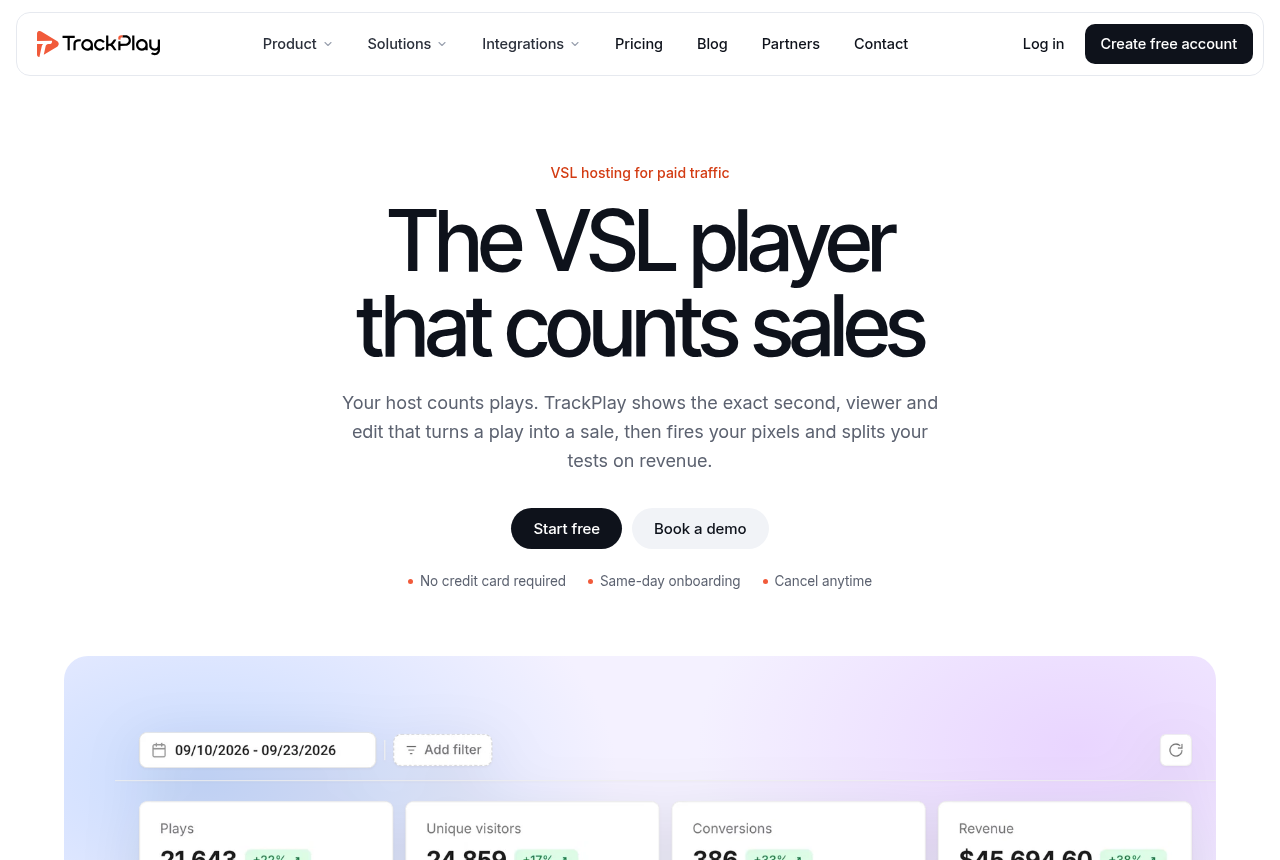
If you landed on Vimeo versus Bunny Stream because you are running paid traffic to a video sales letter, the honest answer is that neither was built for that job and TrackPlay was. It is a VSL player and analytics platform for paid-traffic funnels. On the front end it holds attention with sound-first autoplay, timed CTAs and watch gates. On the back end it draws per-second retention split into buyers and non-buyers, with hook rate, hold rate and revenue per play, so you can see the exact seconds to cut or protect.
What sets it apart from both tools on this page is attribution. Vimeo gives you a polished host and Bunny the cheapest delivery, but neither ties a play to the sale. TrackPlay does: the cart posts the verified sale back onto the play that earned it, and TrackPlay fires that conversion server-side to Meta, TikTok and GA4, so the ad platform learns from the actual sale rather than a page-load pixel. Its split tests are decided on that cart-verified sale with real statistics, a z-test with a p-value and a confidence interval, and every variant runs under one embed so your ad links and campaign learning never reset. It bills by plays rather than bandwidth, every feature ships on every paid plan, and there is a no-card free plan of 1,000 plays a month plus a 14-day trial, with paid plans from $29 a month.
What works
- Split tests are decided on the cart-verified sale, with a real z-test, p-value and confidence interval, and every variant runs under one embed so ad links and campaign learning never reset
- Server-side conversion tracking to Meta, TikTok and GA4 fires on the watch-time milestone you choose and dedupes browser and server events, so the ad platform optimizes on the actual sale rather than a page-load pixel
- Cart postbacks tie each sale to the play that earned it from seven direct-response carts, including ClickBank, ClickFunnels and Digistore24, server to server
- Per-second retention split into buyers and non-buyers, with hook rate, hold rate and revenue per play
- Every feature ships on every paid plan and billing is by plays, with a no-card free plan of 1,000 plays a month and a 14-day trial; paid plans start at $29 a month
What to watch
- Narrow by design: built for paid-traffic VSL conversion, it is not a general video host or a B2B content library, so it has none of the channels, SEO pages or webinar tooling of a Wistia and is a poor fit if the video's job is content marketing rather than a direct-response sale
- Very new, with thin outside proof: the testimonials are on its own site, there is little third-party review or Reddit footprint yet, and signup is currently invite-only, so you cannot lean on independent validation before you commit paid traffic. That is what you would expect of a platform this recent
Where TrackPlay is not the answer
It is narrow by design. TrackPlay is built for paid-traffic VSL conversion, not general hosting, so it is not a general video host or a B2B content library and it has none of the channels, SEO pages or webinar tooling of a Wistia. If the video's job is content marketing rather than a direct-response sale, it is the wrong tool: host on Vimeo for clean playback, or reach for a marketing host like Wistia. It is also very new, with thin outside proof: the testimonials are on its own site, there is little third-party review footprint yet, and signup is currently invite-only, which is what you would expect of a platform this recent. Pilot it on one funnel and reconcile the numbers against your own cart before you trust it with a launch.
Visit TrackPlay for the current plans and the free tier.
Pricing, tier by tier
Vimeo sells per-seat plans. There is a free tier, then Starter at about $12 a seat a month with 2 TB of storage and 2 TB a month of bandwidth, Standard at about $25 a seat which adds player-branding removal, custom CTAs and lead-capture forms, and Advanced at about $75 a seat which adds live events, Q&A and polls. Enterprise is custom. For a VSL the interesting tier is Standard, because that is where the in-player CTA and lead form live, so budget for $25 a seat rather than the $12 headline if you want the marketing pieces Vimeo does offer.
Bunny does not sell plans. You pay for what you use, with a $1 monthly minimum, and the player, transcoding and security features are all free. Storage is billed from $0.01 a GB and delivery from $0.005 a GB on the Volume network, or $0.01 a GB on the Standard network in Europe and North America. Bunny's own calculator prices a 300 GB library serving 50 GB a month at about $3.25 to $4.50 before extra replication regions. Every account starts on a 14-day trial with no card.
TrackPlay prices on a third axis again: plays, not seats or gigabytes. A no-card free plan covers 1,000 plays a month with a watermark, a 14-day trial opens the paid features, and paid plans start at $29 a month with every feature on every tier. For a single sales letter that lands between Vimeo's per-seat plans and a Bunny build, with the difference that the whole product is aimed at proving which paid traffic bought. Watch the play count, not a bandwidth line, as the number that scales your bill.
The running cost is where they part hardest, and it is the whole reason to look past the sticker price. Vimeo's self-serve accounts carry a 2 TB per month bandwidth threshold, and its help center says crossing it can prompt Vimeo to move you toward a custom or Enterprise plan. That is exactly the wall a paid-traffic VSL hits: through 2025 and 2026, Reddit threads have filled with long-time subscribers hit by renewal increases and bandwidth caps, including one asking whether anyone else is "getting killed by Vimeo's new bandwidth caps" and another titled simply "Stop paying Vimeo after a decade". Vimeo also agreed in September 2025 to be acquired by Bending Spoons for $1.38 billion, which has left buyers unsure where the plans go next. Bunny's per-GB delivery, by contrast, just scales: send twice the traffic, pay roughly twice the delivery, with no plan migration and no renegotiation.
So the money question is not which is cheaper, because Bunny plainly is, by an order of magnitude at any real volume. It is what Vimeo's premium buys. On these two the answer is convenience, not conversion: Vimeo gives you a finished, branded, no-code player and the platform around it, and you pay for not assembling anything. Bunny gives you the cheapest reliable delivery and a player you have to dress yourself, usually by putting Presto Player or Vidstack in front of it and wiring in your own opt-ins, CTA overlays and tracking. That is a genuine build, and the assembled cost and effort are the honest thing to weigh against Vimeo's out-of-the-box simplicity. If you or your developer will do the build, Bunny is far cheaper and scales without surprises. If you will not, Vimeo is the shorter route to a live player, at a price that can move under you.
The verdict
Between these two, pick on whether you are buying a finished product or the cheapest possible part. Neither is a conversion tool, so the tie-breaker is the delivery underneath and how much you are willing to build on top of it. Bunny Stream is the cheapest, most reliable way to move video bytes, and at paid-traffic volume its per-gigabyte pricing beats Vimeo's capped plans without the risk of a forced migration or a renewal shock. For a marketer who is going to bolt a player and tracking on anyway, that cheaper, more predictable base is the better foundation, which is why it wins here.
If you will not build, though, Vimeo is the right pick, and it is not a consolation prize. It hands you a polished branded player, a no-code embed, and on its Standard plan the in-player CTAs and lead forms a VSL can actually use, with none of the assembly Bunny demands. The trade you accept for that is a 2 TB a month bandwidth ceiling and a pricing history that has bitten buyers at scale. The tie-breaker is build versus buy: if you or a developer will assemble the player and the tracking, use Bunny and keep your masters backed up; if you want to upload, embed and move on, buy Vimeo and watch the bandwidth meter.
One exception sits outside that build-versus-buy call. This site is for direct-response marketers, and if the video is a paid-traffic sales letter the tie-breaker changes. You need a player that scores its split tests on the sale and fires the conversion back to your ad account, and that is the one thing neither Vimeo nor Bunny does. TrackPlay is built for exactly that, so for that reader it is the pick over both. It is narrow and very new, so pilot it first, but it is the tool on this page made for a sales letter.
Our pick
Bunny Stream
Bunny Stream is the pick for this site's core reader, a marketer buying cold traffic and sending it to a video sales letter, once the shortlist is down to these two. Neither of them does the conversion job, so the choice comes down to the delivery underneath, and at paid-traffic volume Bunny wins it decisively: delivery is billed per gigabyte at a fraction of a cent, the bill scales smoothly with traffic, and there is no bandwidth cap waiting to push you onto a custom plan. The catch is real. Bunny is infrastructure, not a product: you get a bare customizable player and you build the CTA overlays and the tracking yourself, usually with Presto Player or Vidstack on top. If you will not build, Vimeo is the better pick, because it hands you a polished branded player and a no-code embed and, on its Standard plan, in-player CTAs and lead forms. Weigh Vimeo's 2 TB a month self-serve bandwidth threshold and its recent pricing changes before you commit a high-traffic offer to it.
Frequently asked questions
Is Vimeo or Bunny Stream better?
Which is cheaper, Vimeo or Bunny Stream?
Can either one run a video sales letter for paid traffic?
Do I have to build the player and tracking myself on Bunny?
Why does Vimeo's bandwidth cap matter for a VSL?
Is Bunny Stream reliable enough for a revenue offer?
Is Vimeo still safe to buy after the Bending Spoons acquisition?
Sources
Other sources
10 discussions and reviews read for this page. Quotes are excerpts; open a link to read the original in context.
- [] Vimeo pricing plans (vendor)
- [] Bandwidth on Vimeo (vendor help center)
- [] Vimeo to be acquired by Bending Spoons for $1.38B (vendor press)
- [] Bunny Stream (vendor)
- [] Bunny Stream pricing (vendor)
- [] TrackPlay (vendor)
- [] Is anyone else getting killed by Vimeo's new bandwidth caps? (r/ycombinator)
- [] Stop paying Vimeo after a decade (r/vimeo)
- [] BunnyCDN has been silently losing our production files (r/webdev)
- [] Bunny CDN Stream Extremely Slow (r/webhosting)